

Environmental scoring systems in France & Belgium
1st February 2021
Germain Milet, Market Specialist France & Belgum, Bord Bia – The Irish Food Board
Will 2021 be the environmental labelling year in French speaking markets? The matter has been debated for years in France and is included in the French law “against food waste for a circular economy” that is supposed to come into force by the end of 2021 (french ministry for ecology[1]). By then an official Ecoscore should be available to assess the environmental impact of any food product. Any manufacturer should be able to use this indicator on pack, following the same model as the now famous Nutriscore.
For years this National Ecoscore faces opposition from both ruminant sectors and organic farming organizations. In fact the calculation method proposed is mostly based on LCA (Life Cycle Assessment), a method that calculate the GHG emissions per kg of finished product. LCA is accused of favouring industrial/intensive production against grazing/low input systems, by calculating impact per kg of product without considering nutrient quality and positive externalities. The French government shared a preliminary Ecoscore calculator called Agribalyse that confirms these fears. According to Agribalyse a 1kg pork sausage produces 8.05 kg of CO2 equivalent[2] whereas 1kg of minced beef produces 20.24 kg of CO2 equivalent[3], and would therefore score significantly lower.
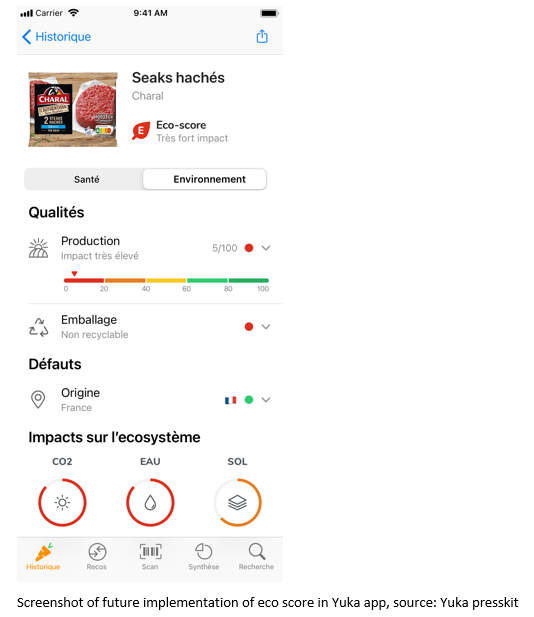
Seeing the opposition from farming organization and considering the lack of evolution on the topic for year a collective of companies linked to the food industry (Yuka, Openfoodfacts, Marmiton, Foodcheri…) released its own private Eco-score in January and started using it with the online retailer La Fourche. This ecoscore is based on LCA but includes a bonus/malus system supposedly correcting LCA’s main weaknesses by favouring local, extensive or organic systems. That decision sparked anger within Interbev, the professional organization for ruminant meat in France calling it a “communication tool”.

The collective is not alone, in fact not less than 2 other initiatives were launched in January 2021. Firstly Färm, a Belgian Organic retailer, launched Färmoscope[1] a sustainability indicator assessing product according to 6 criteria including origin of products and location of processing site. Secondly
Invitation à la ferme, a French network gathering of farm made yogurts producers started displaying the estimated carbon footprint of its products compared to an average industrial product.
Sources:
[1] https://www.france-carbon-agri.fr/possible-interessante-et-accompagnee-objectif-bas-carbonne/
[1] https://www.gondola.be/fr/news/farm-lance-son-propre-indicateur-de-durabilite
[2] https://www.agribalyse.fr/app/aliments/30050#Chair_%C3%A0_saucisse,_crue
[3]https://www.agribalyse.fr/app/aliments/6260#Hach%C3%A9_%C3%A0_base_de_b%C5%93uf_ou_Pr%C3%A9paration_de_viande_hach%C3%A9e_de_boeuf,_15%_MG,_cru
[5] https://www.france-carbon-agri.fr/possible-interessante-et-accompagnee-objectif-bas-carbonne/