Padraig Brennan, Sectors Director, Bord Bia - The Irish Food Board
Changes in the China market are continuing to shape the global market environment for meat, especially pigmeat. This is demonstrated by the most recent market outlook published by Rabobank, which estimates that the Chinese pig herd has declined 40% year on year due to the impact of African Swine Fever (ASF). While China’s production is expected to fall at a slower pace in 2019, it is still likely to be 25% lower than 2018, which equates to a drop of around 13 million tonnes. A further fall of up to 15% is being projected for 2020 with recent trade commentary suggesting that it could take more than five years for the market to rebalance itself.
The changing supply picture in the market is resulting in a strong lift in pigmeat import demand in China with volumes in May some 62% ahead of May 2018 levels. On a year to date basis volumes are almost 20% higher. The reduced domestic output is also impacting on prices with hog prices in July running 41% ahead of last year. Meat prices have increased increased strongly over recent months with July prices running 15% - 20% higher than a month previous. This is boosting the global pigmeat trade with European pig prices running more than 20% ahead of last year.
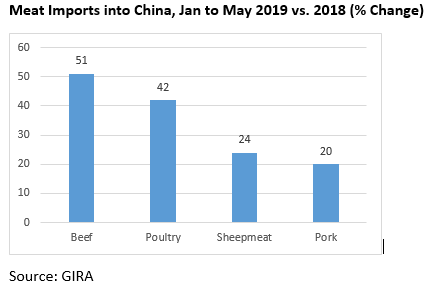
Total meat imports into China are growing strongly with beef and poultry imports showing the strongest growth according to GIRA. Up to the end of May beef import volumes were running over 50% ahead of the same period in 2018 with poultry 42% higher and sheepmeat rising by 24%. These trends seem set to continues for the rest of 2019 and into 2020.
Irish meat exports to China have reflected this increased demand with figures for the first five months of 2019 showing a rise of 42% in pigmeat exports to almost 34,000 tonnes while beef exports amounted to almost 3,000 tonnes over the period as result of access being granted for Irish beef to China in the first half of 2018. Awareness of Ireland as a source of high quality pigmeat and beef continues to grow and should provide a solid basis for further growth in the months and years ahead.
ASF continues to affect much of Asia with cases recorded in Vietnam, Laos, Cambodia and North Korea. Vietnam’s pork production is expected to fall by up to 20% in 2019, which will impact on supply demand dynamics across the region.