

Michael Hussey, Regional Director Middle East, Bord Bia – Irish Food Board
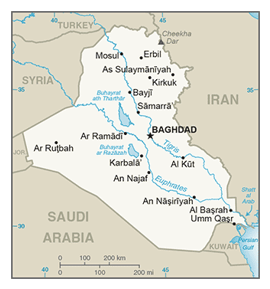
Iraq or the Republic of Iraq as it is officially known, is located in the Middle East, bordering the Persian Gulf between Iran and Kuwait. As well as Iran with which it shares a 1,599 km border, and Kuwait (254 km) Iraq borders Saudi Arabia (811km), Syria (599 km), Turkey (367 km), and Jordan (179 km). It has a land area of 437,072 square kilometers and a 58 km coastline on the Persian Gulf on which are situated the ports of Bara and Umm Qasr.
Iraq is a major importer of dairy products as much of the Iraqi dairy processing sector has been destroyed during years of conflict. Any consideration of Iraq trade data must be preceded by a warning as to its shortcomings. With 3,809 km of land borders and a country seemingly in perpetual conflict, the potential for smuggling is great. From recent research in Jordan for example,’ it is tentatively estimated that that country exports some 17,000 tonnes of retail powder to Iraq, but only about 3,000 tonnes of exports are identifiable in trade data. Similarly there is no significant powder exports recorded from the UAE to Iraq although the powder sold by Nestlé’s official importer is packed in the UAE. Nevertheless it is useful to briefly consider the trade data.
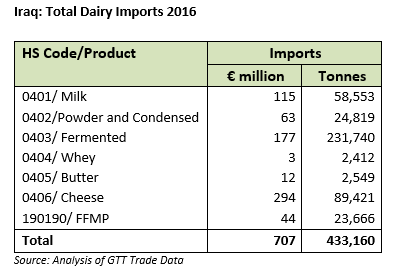
Based on available trade data the country imported some 433,160 tonnes of dairy product in 2016 (in product weight terms) worth €707 million. How much more was imported illegally, without being captured in trade data or misclassified is impossible to say, though likely to be significant.
According to the import data the main import categories were cheese valued at €294 million, yoghurt and fermented products worth €177 million, milk €115 million and powder and condensed milk worth €63 million (of which SMP €36 million and WMP €18 million). An additional €44 million worth of FFMP was imported. Exports were relatively insignificant.
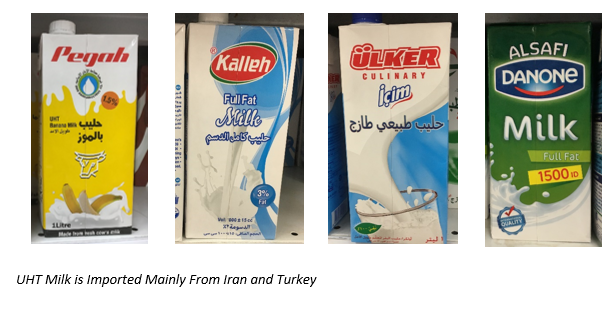
Iran is the leading supplier in most product categories including cheese (accounting for 46% of imports in 2016), yoghurt and other fermented products (99% of imports), milk (62%), SMP (32%), WMP (42%) and butter (27%). Other important supplier countries include Turkey and Saudi Arabia for milk yoghurt and cheese, and Europe (mainly Netherlands, France, Belgium and Denmark) for butter. As the security situation improves there may be opportunities for Irish suppliers to forge new relationships with dairy importers in Iraq.
Sources: GTT, Brian McNulty and Associates, Bord Bia