

Claudia Saumell, Madrid Office, Bord Bia – Irish Food Board
The agriculture sector is of key importance to Morocco’s economy, representing approximately 14% of total GDP (75bn MAD/ €6.6bn) and approximately 7% of exports (2009). Livestock represents 38% of total agriculture sector.
The Dairy Plan put in place by the government of Morocco around the mid-1970s (Plan Laitier, 1975) had the objective of bolstering both national production and consumption of fresh milk by offering fiscal incentives on importation taxes to farmers to import pure-bred and cross-bred dairy cattle in order to improve the genetics of the national herd. The policy was very successful and achieved its objectives: In 1975, the volume of fresh milk production was 580m litres and consumption per capita was 35 litres. In 2009, it grew up to 2bn litres per year and 50 litres per capita. Since 1975, farmers have been importing dairy heifers from Germany, France and the Netherlands. Dairy heifers had to be max 30 months and min 3 months in-calf and guarantee milk production of 6000 litres/year.
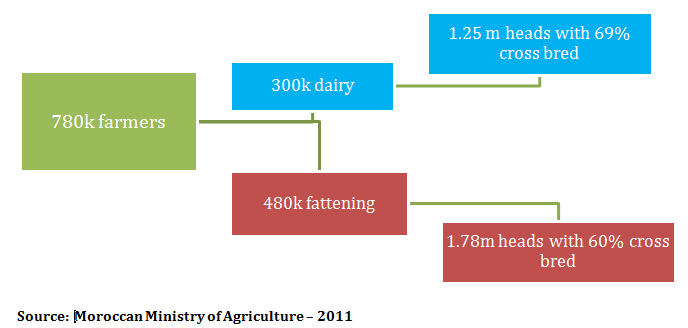
This policy, however, prompted a weak beef cattle sector and poor quality meat. In 2010, in order to improve the beef cattle sector, the government of Morocco approved new incentives (Plan Maroc Vert) that made farmers to switch from dairy cattle to beef cattle; there was a subsidy of 4000 DHM (€356) for each calf born in Morocco with improved genetics. The result of this new plan is that nowadays, there is a lack of dairy heifers in Morocco. From the 3 million herd that Morocco has currently, 1.8 million is for fattening and 1.2 million for dairy. The total number of farmers is 780,000.
For more information contact Claudia.samuell@bordbia.ie