

Liz Whitehouse, Bord Bia - The Irish Food Board
South Africa is Africa’s 2nd largest economy and represents a sizeable market for imported poultry. In 2018, according to UN COMTRADE statistics, the country was the sixth largest importer of poultry in the world. Over the last 10 years, local production of poultry has remained at more or less the same level whilst the population has increased from 48.6 million to 57.7 million and per capita consumption of white meat has risen from 39,74kg to 42,32kg[1].
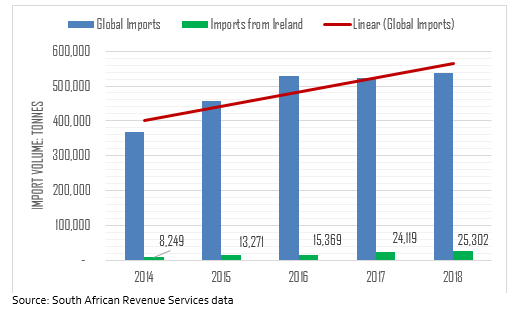
In 2018, South Africa imported 536,700 tonnes of poultry (chicken) to the value of €383 million. South Africa’s poultry import market has grown steadily across the last five years registering a 46% increase in volumes imported. Brazil enjoys the largest share of the import market at 63% of total volume in 2018. Ireland as a source of supply has done particularly well reflecting growth of 207% in volumes and growing import market share from 2% to 5% in five years. Although the import figures for January to July 2019 reflect marginal growth in global imports, Ireland looks set for another good year with import volumes already 14% up over the same period in 2018.
Whilst the picture may look rosy for a foreign supplier, the local poultry industry is not happy with the level or growth of poultry imports. Industry maintains that they simply cannot compete against unchecked imports that are being dumped in South Africa at a cost below that at which it is possible to produce in the country of origin. The representative body, the South African Poultry Association (SAPA), has calculated that South Africa could create 30 000 jobs by replacing chicken imports, a meaningful contribution to an economy with an official unemployment rate of 29%.
Against this background SAPA applied earlier this year to the International Trade Administration Commission for South Africa (Itac) for an 82% tariff increase on imports from non-EU and non-SADC suppliers from the current 12% tariff on frozen boneless cuts and 37% on frozen bone-in pieces. SAPA is adamant that the application is not an attack against imports but against dumping. The Association of Meat Importers and Exporters (AMIE) has commissioned their own study to counter the SAPA argument and maintains that a tariff increase would impact on supply and raise prices and that alternative policy measure should be investigated.
1.Department of Agriculture and Forestry. Abstract of Agricultural Statistics 2019