

Global food prices in decline, but can it be sustained?
John Tobin, Data and Market Intelligence Specialist
Since the invasion of Ukraine in early 2022 commodity prices have experienced a period of extreme volatility, the effects of which have been more pronounced in some regions over others. However, in the latter stages of 2022 and into 2023 prices have started to decline albeit continuing to remain at elevated levels. This is indicated by the FAO Food Price Index is which for June 2023 has declined by 1.7 percentage points to 122.3 compared with 159.7 in March 2022.
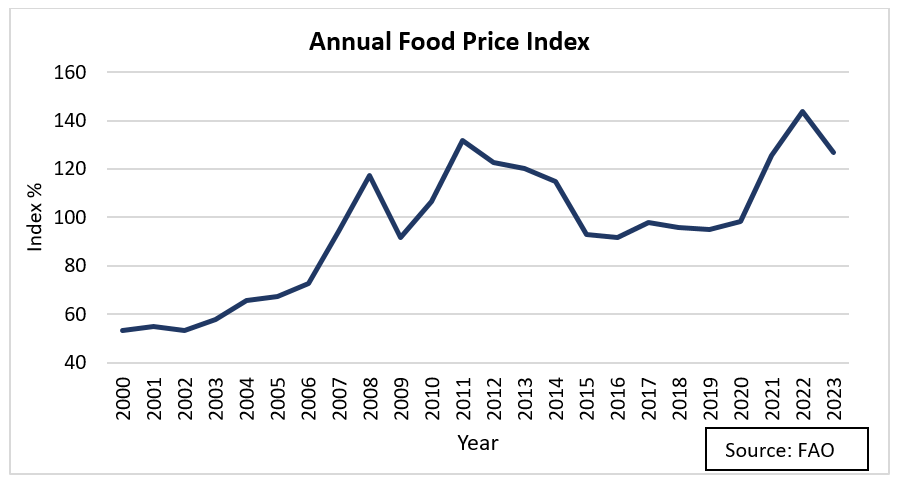
While such a decline and especially the magnitude of this decline in such a short period may come as welcome news, it is worth highlighting that the current measure of 122.3 still remains at an elevated level when compared with recent years as shown in the above chart. As part of this index, the FAO generates a number of sub-indices which feed into this overall index covering products such as cereals, vegetable oil, meat, dairy and sugar. Looking at these sub-indices all saw declines in June compared with the prior month with the exception of meat which remained unchanged compared May 2023.
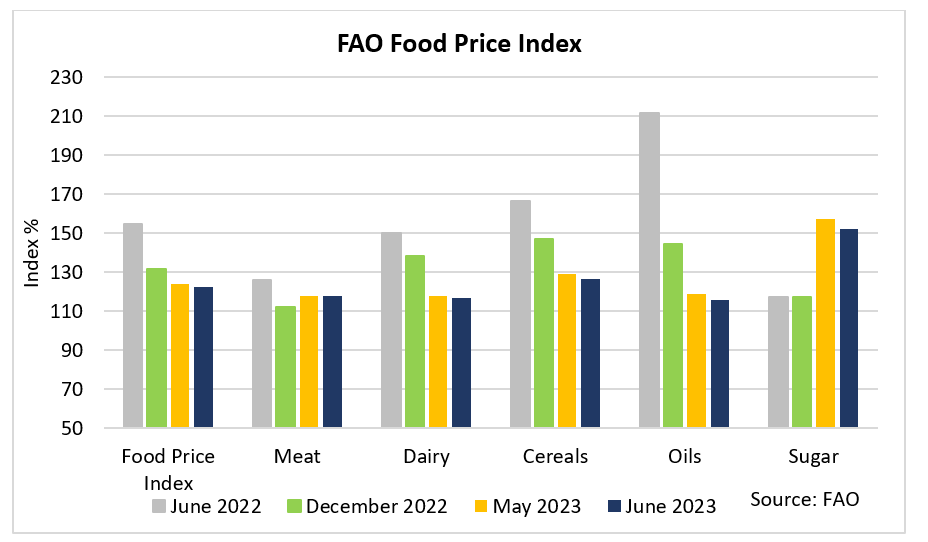
Within meat the picture varies by species. Overall, both poultry and pork prices increased by more than enough to offset declines in beef and sheepmeat prices. In the case of pork, the increase in prices was attributed to tight supplies in important producer regions most notably the EU where production is down 24% for the year to May 2023 vs. the same period in 2022. Whereas the ongoing outbreaks of Avian Influenza has resulted in supply challenges coinciding with high import demand for poultry from East Asia. The decline in beef and sheepmeat prices was largely attributed to increased supplies from Oceania, especially Australia where exports of beef and sheepmeat to for the year to June are up 20% and 22% respectively (Meat and Livestock Australia, 2023).
In the case of dairy, the index declined to 116.8 down 1 percentage point from May. The widespread availability of cheese especially in Western Europe where retail sales as described as being subdued and a cooling of import demand for whole milk powder in Asia and increased supplies of this product from New Zealand were highlighted as a contributory factors to the decline in this index. Meanwhile, world butter prices and skim milk powder to a lesser extent saw an increase in prices during the month.
The cereal and vegetable oil price indices both saw declines of in excess of almost three percentage points to 126.6 and 115.8 respectively and both indices have seen the steepest falls since the beginning of 2023 by in excess of 20 percentage points. The reduction in the cereal price index is attributed to a decline in quotes for all major cereals traded globally. Maize prices have declined for five consecutive months to date reflecting good harvests in Argentina and Brazil while recent moisture in the US has helped to improve the prospects of the current crop effected by drought conditions. Wheat prices were also noted as declining in June which was helped by plentiful supplies in Russia who also reduced the wheat export tax. In the case of vegetable oil, concerns surrounding the ongoing war in Ukraine and the continuation of the grain corridor remaining open for exports from Ukraine is a key factor that is being watched by traders (Holland, 2023) and (Low, 2023).
With regards to sugar, June saw the sub index fall by five percentage points, the largest fall for sugar since April 2020. This is the first decline in 2023 with the index still up by 35 percentage points compared with June 2022. This increase vs. last year mostly took place in H1 2023 as main producing countries such as India, China, Thailand and Pakistan revised down production estimates, compounded by a poor EU beet crop. However, according to the FAO more recently the good progress achieved with South America’s sugarcane harvest led to the most recent decline plus subdued demand from China (the largest importer of sugar) (Shan, 2023), with imports down almost 18% in volume and value terms (IHS Markit, 2023).
In conclusion it appears that food prices have declined from their recent peak, however relative to the longer-term trend prices remain quite high and are comparable with previous highs witnessed in 2007 and 2012 when commodities last experienced a global boom period. While the decline may come as a welcome development it must be recognised that it still remains a volatile time period and any supply shocks owing to an escalation in the war in Ukraine, a weather event etc. can potentially undo recent declines achieved. For Irish food and drink businesses managing ingredient or input prices will continue to remain a key priority at current levels and to manage the risk that such prices may increase once more. Staying informed of price developments will allow Irish food and drink businesses to have meaningful and informed conversations with their customers and to communicate effectively the scale of the challenge these volatile times present to their businesses.
The hosting of commodity pricing webinars by Bord Bia in partnership with StoneX can help you and your businesses mitigate the risk to your business of food price inflation. If you require further insight on global commodity price trends or would like to attend future webinars Bord Bia may organise in this area please get in touch by emailing thethinkinghouse@BordBia.IE.
Bord Bia will be hosting another commodity pricing webinar in partnership with StoneX later this year with the date yet to be confirmed. Should you wish to receive an invite for this event, please email john.tobin@bordbia.ie.
References:
FAO. (2023, July 7). FAO Food Price Index | World Food Situation | Food and Agriculture Organization of the United Nations. FAO. https://www.fao.org/worldfoodsituation/foodpricesindex/en/
Holland, K. (2023, April 21). EU Sunflower Oil Prices Decline Whilst Concerns around the Grain Corridor Continue. Www.mintecglobal.com. https://www.mintecglobal.com/top-stories/eu-sunflower-oil-prices-decline-whilst-concerns-around-the-grain-corridor-continue
IHS Markit. (2023, June). ihsmarkit.com. https://connect.ihsmarkit.com/gta/standard-reports
Low, N. (2023). Edible oils are facing a supply crunch. Reuters. https://www.reuters.com/plus/edible-oils-are-facing-a-supply-crunch
Meat and Livestock Australia. (2023, July 4). Export trade dashboard | Meat & Livestock Australia. Meat and Livestock Australia. https://www.mla.com.au/prices-markets/overseas-markets/export-trade-dashboard/
Shan, L. Y. (2023, April 19). Sugar prices spike to 11-year high and could rise further due to extreme weather. CNBC. https://www.cnbc.com/2023/04/20/sugar-prices-spike-to-11-year-high-and-could-rise-further-due-to-extreme-weather.html