

Forecast of the French beef market for 2024: Production still declining, consumption expected to stabilize
Orla Murphy, International Graduate, Paris Office
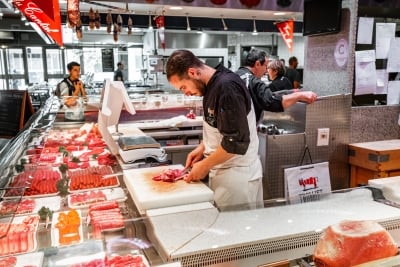
Idele is forecasting a decline in beef production in 2024, which would be the 4th year running. The persistent reduction in dairy and suckler herds over the past seven years is limiting the cattle throughput, despite the renationalization of young cattle fattening, which is the main short-term response to this drop in production. Virtually stable consumption would then lead to a rebound in meat imports. Weanling exports would continue to fall significantly.
Idele’s prediction for France Beef supply and consumption in numbers
|
1000 tcwe |
2018 |
2019 |
2020 |
2021 |
2022 |
2023e |
2024p |
2023e/22 |
2024p/23e |
|
Throughput |
1467 |
1429 |
1435 |
1425 |
1361 |
1298 |
1282 |
-4.7% |
-1.2% |
|
Imports |
327 |
333 |
279 |
314 |
378 |
356 |
368 |
-5.7% |
+3.4% |
|
Exports |
244 |
231 |
226 |
250 |
245 |
215 |
220 |
-12.2% |
+2.2% |
|
Total Consumption |
1550 |
1531 |
1488 |
1488 |
1493 |
1438 |
1430 |
-3.7% |
-0.5% |
|
French beef cons. |
1223 |
1199 |
1209 |
1174 |
1116 |
1082 |
1062 |
-3.0% |
-1.8% |
e = estimated, p = predicted
Source : GEB-Idele economics department
French beef production down 1.2% in 2024
After two consecutive years of approximately 5% reduction, net production of finished cattle is set to fall again in 2024, but at a slower pace: -1.2% compared with 2023 to 1.282 million tonnes Carcass Weight Equivalent (CWE). Female production and steer production would fall by -1.8% each, and veal production by -5%, with only bulls and bull calves recording an increase of +1.8%. Weanling exports are set to fall further (-5%), following a very sharp drop in 2023 (-7%).
Decline in female production
After a sharp decline in 2023 (-5.9% compared to 2022), female slaughterings should continue to fall in 2024, but more moderately (-1.8%). Dairy and suckler culls will again be significantly reduced, with an expected slowdown in depopulation. Heifer slaughterings are expected to remain stable.
The depopulation of the suckler cow herd, which began in the summer of 2016, has slowed during 2023: the annual rate of decline in the herd has fallen from -3.0% at the end of 2022 to -2.1% at the end of 2023. The number of cows entering the national suckler herd in 2023 fell, but not by as much as the number of cull cows leaving the herds, which fell sharply. This slowdown in depopulation could continue in 2024, ending the year at -1.7% annualized. With fewer cows leaving the farm, throughput would fall by 3.1% in 2024.
Dairy depopulation has also slowed down in 2023, from -2.3% at the end of 2022 to -1.9% at the end of 2023. This slowdown is set to continue (-1.6% at the end of 2024), thanks to an attractive milk price for producers and rather substantial forage stocks at the end of 2023. This should go hand in hand with the retention of cows on farms, especially as there are still few replacement heifers ready to enter production in 2024: throughput would fall by 2.5% in 2024.
Fewer veal calves
After two years of very sharp declines (-7% in 2022 and 2023), veal production is set to continue its structural decline in 2024 (-5%). Veal production is facing several challenges: sluggish consumption, which is prompting integrators to regulate production to maintain a fluid market, the sharp rise in construction costs for new buildings, etc. Therefore, export of French young calves should be rising again, mostly toward Spain.
Increase in young bull production
The number of bulls is set to increase by almost +2% in 2024. The current number of males to be slaughtered in 2024 is on the rise in French farms, with slightly more slaughtering in the first half of the year, but slightly fewer in the second. This recovery can be explained by two factors: a rebound after historically low production in 2022 and 2023 and the development of production taking place under more contractual arrangements.
Fewer weanlings for export
Following the drop in 2023 (-7%), weanling exports are set to fall by a further -5% in 2024 (-50,000 head), due to the contraction in availability and the relocation of fattening operations in France.
Increase in imports for virtually stable production
By 2024, calculated beef consumption could be virtually stable (-0.5%). This is because beef remains attractive to consumers who have already restricted their consumption in 2023. It is also still well promoted in the foodservice sector, giving it high visibility and access to the growing food service market. The Olympic and Paralympic Games will also bring in several million additional tourists, helping to maintain consumption over the summer months. However, French meat consumption in France is set to decline (-1.8% vs. 2023), due to lower production in France. Imports should increase (+3%) to compensate for the decline in slaughterings and slight increase in exports.
Source:
Groupe Economie du Bétail GEB (Institut de l'Elevage) (2024). Prévisions viande bovine 2024 : la production baisse encore, mais moins vite qu’en 2023. [online] Institut de l’Élevage. Available at: https://idele.fr/detail-article/previsions-viande-bovine-2024-la-production-baisse-encore-mais-moins-vite-quen-2023 [Accessed 26 Feb. 2024].