

Alcohol Brands - Options on Adaptation through Covid
19th October 2020
Jane Leydon, Strategic Insight & Planning, Bord Bia - The Irish Food Board
This FoodAlert will examine how alcohol brands can adapt and embrace change to deal with the challenges Covid-19 brings for the alcoholic drinks industry. It will set out the four key learnings from WARC’s ‘What’s Working in Alcoholic Drinks’ (2020), which are;
- Continue to advertise during the recession
- Support the hospitality industry in creative ways
- Use digital channels to create shoppable experiences
- Get the e-commerce shopping experience right
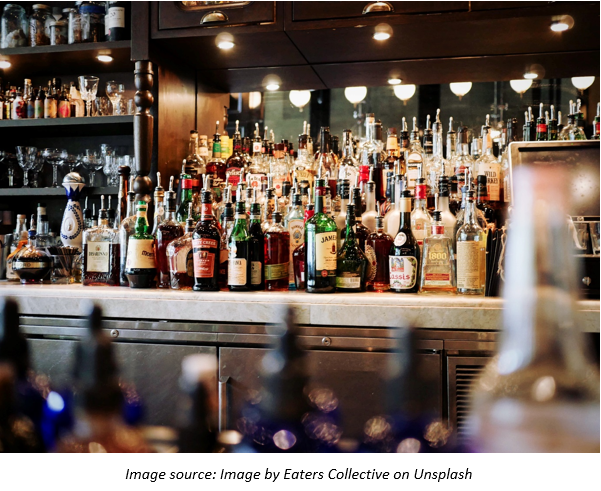
The pandemic has changed consumer purchasing behaviour for alcoholic drinks. A new report from IWSR Drinks Market Analysis predicts significant declines in 2020 for total global alcohol consumption. It warns that it will take until 2024 to recover globally to pre-Covid-19 global alcohol consumption rates (King, 2020). CEO of IWSR Drinks Market Analysis, Mark Meek, tells Fortune (King, 2020) that although the full impact of the current Covid-19 situation is still being assessed, it is very clear that the pandemic is set to cause a deeper and more long-lasting impact on the global drinks industry than anything experienced before, including the downturn following the 2008 financial crisis (King, 2020).
It is therefore very important that alcohol brands reset and adapt the business to what will likely be a very different set of worker, customer and consumer priorities (Wright, 2020).They must focus on renewing and scaling operations to support a resilient business model to help drive the return to growth once the peak of the crisis has passed (Wright, 2020).
1. Alcohol brands should keep advertising during the recession
While global alcohol advertising investment has fallen significantly in 2020 due to the pandemic, investment must not be ignored as it will prove to be crucial at this time. Marketing Professor Gerrard Tellis has signalled the alcoholic drinks industry as a winning category in the Covid-19 recession. He has highlighted that alcoholic drinks brands should continue to invest in advertising during this recession (WARC, 2020).
However, investment at this time will be challenging for alcohol brands who are undoubtedly under pressure as they face the revaluation of their business models. Given that finance continues to have a vital role in preserving cash in the short term and creating protective buffers for the future, investments will inevitably need to be paused, and costs will need to be cut (Wright, 2020). Nevertheless, it is crucial that the Covid-19 response is also used as an opportunity to review investment priorities and rebalance portfolios to help the business adapt to changing consumer behaviours and ultimately gain competitive advantage as economies start to recover (Wright, 2020).
Gerrard Tellis’ prediction that the alcoholic drinks industry will be a winning category in the Covid-19 recession is based on evidence from past recessions, where companies that maintained their investment generated higher growth than those who reduced budget and went dark (WARC, 2020). Naturally, in difficult times, brands tend to reduce their advertising. This results in an overall decline in media costs and advertising competition (WARC, 2020). As a result, investment at this time is more lucrative, with the companies choosing to invest, getting twice as much value for their investment (WARC, 2020). Furthermore, investment during this time will provide a valuable advantage in building brand revenues ahead of competitors, which will prove beneficial when on trade channel reopen (WARC, 2020).
Undoubtedly this will be the most testing period many companies have experienced and they must strike a balance in their reactive measures. The present crisis will pass and growth will return and as such, leaders must balance their management of the immediate challenges while also understanding and anticipating the longer-term implications for their business models (Wright, 2020).
2. Support the hospitality industry in creative ways
Bars and restaurants, often social focal points of communities, have been hit hard as a result of Covid-19 shutdowns. Until a vaccine is found, restrictions and lockdowns will continue to impact on-trade consumption for the foreseeable future (Wright, 2020). This situation is leaving employees struggling financially and in the worst case it has forced some popular night life businesses, bars and restaurants to permanently close (WARC, 2020)
Alcohol companies can respond to this situation constructively by maximising the opportunities in the channels where demand is now surging (Wright, 2020). This will require collaboration and partnership with on-premise outlets, wholesalers and retailers, as well as delivery partners like Deliveroo (Wright, 2020). Alcohol brands should embrace a purpose driven approach to foster relationships with the hospitality industry by listening to them and acting quickly to plug any gaps in on-trade or direct-to-consumer channels (Wright, 2020). Investing and prioritising in building trust and brand authenticity with partners, consumers and communities, and letting immediate profit considerations take a back seat during this time, will benefit alcohol brands in the long term (WARC, 2020).
As more consumers seek a premium drinks experience in their own home during Covid-19, this presents alcohol brands with an opportunity to build engagement by using new approaches in the social media space. For example, working with hospitality partners to create ‘influencers’ and brand advocates and using social media platforms for brand building rather than short term metrics (WARC, 2020). Brands should aim to use digital collaboration tools to support people’s emotional needs as well as their physical safety at this time (Wright, 2020).
Jagermeister is an example of a brand who have adopted this approach. Since they are extremely reliant on out of home consumption, they chose to adapt quickly to the pandemic by keeping nightlife alive with their popular virtual community; #SaveTheNight platform (WARC, 2020). It is a platform that lets consumers book artists such as DJs and musicians for online parties. This gives consumers their own personalised virtual experiences with their friends. It engages with those consumers who are feeling the loss of going from having moments of togetherness in bars to being homebound, while also supporting the entertainment and hospitality employees who have lost their income (WARC, 2020)
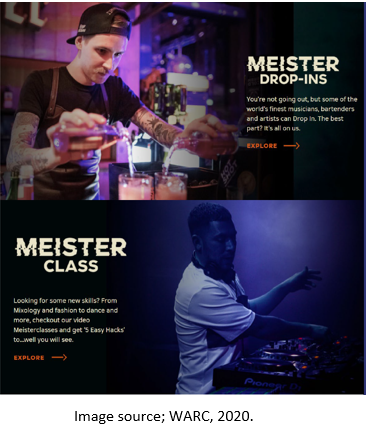
Jagermeister will reap the benefits of this in the long term as it will increase brand and employee loyalty and the use of online tools and platforms – accelerating the digital transformation that was already underway (Wright, 2020).
Carlsberg is adapting to support bars and restaurants in Denmark with their “adopt a keg” initiative. With this initiative, every time someone drinks a bottle or can of Carlsberg at home, they can scan the label and add it to their virtual keg on the Carlsberg’s website. When bars reopen they can then exchange their scanned drinks for free real beers (Wright, 2020).
As consumers adapt to their new reality of spending more time at home, they’re migrating to online channels to find new ways to connect (Wright, 2020). This channel shift presents alcohol brands with the opportunity to get creative about consumer experiences and enhance relationships with consumers further (Wright, 2020). The potential audience for innovative brand experiences is that much higher and brands like BrewDog and Signature Brew have adapted to capitalise on this (Wright, 2020).
BrewDog have created an online bar which serves as a creative way to engage with consumers who can share a beer while social distancing rules are in place (Wright, 2020). East London craft brewery; Signature Brew has taken the pub experience directly into the home with their hand delivered Pub in a Box service. The box contains many of the essentials for a night out in the pub, such as a range of beers with beer glasses, beer mats, a vinyl record, a pub quiz and pub snacks (Wright, 2020).
While consumers are shifting to online channels to fill the gap for human connection, there is also an accelerating shift towards local and community (Wright, 2020). With almost four in five (79%) of global consumers saying that they feel more connected to their communities (Wright, 2020). The Highball Brands, a luxury distribution company in the U.K, adapted to meet this change. They partnered with local bars to launch “The Drinks Drop”, a cocktail delivery service. With this, the participating bars create a cocktail using the Highball brands portfolio of spirits which are delivered in reusable pouches, chilled and ready to drink and all of the profits are evenly redistributed to the participating bars (Wright, 2020).
These channel shifts represent an opportunity for alcohol brands to create social experiences that extend beyond pure entertainment (Wright, 2020). It will help to grow revenue and attract new consumers by generating long term lasting changes that will drive portfolio revaluation across the industries (Wright, 2020). Adapting to these opportunities for growth, will require alcohol companies to be cognisant of the challenge in balancing what they are doing now and what they need to do in the future (Wright, 2020). In addition, from a long term perspective, careful analysis will be necessary to anticipate how many of these new consumer behaviours are likely to stick and then steps must be taken to adapt the portfolio and financial models accordingly (Wright, 2020).
3. Use digital channels to create shoppable online experiences
The usual brand experience has been upended with 95% of consumers saying that they’re now spending more time on in-home media consumption activities (GlobalWebIndex data, WARC, 2020). Alcohol brands have the opportunity to build brand love by creating memorable and engaging experiences online (WARC, 2020). Livestreaming presents a powerful opportunity for brands to engage their target audience in a compelling way during this time when in-person events such as sports games and music festivals are not an option (WARC, 2020). This approach can also be complimented with digital commerce and influencer engagement. This is important because if social distancing continues to be a reality in the long term, this will be a significant growth opportunity (WARC, 2020).
For example, AmBev, the Brazilian brewer, adapted to Covid-19 and livestreamed a concert series on YouTube, promoting several of its beer brands and connecting with its Brazilian consumers (WARC, 2020). It was a great success, generating 24 times more earned media impressions than the FIFA World Cup in 2018. Following this success in Brazil, AmBev have expanded it globally (WARC, 2020).
4. Get the e-commerce shopping experience right and create a delightful doorstep moment!
In terms of investment, it is also important to deliver a positive, helpful and supportive experience and service across the full ecosystem. This is something that consumers will remember positively post- pandemic (WARC, 2020).
Importantly, e-commerce channels are pegged at twice the potential value compared to global travel retail channels as border restrictions are upheld indefinitely (King, 2020) E-commerce success is the leading indicator of long-term omnichannel success and it is critical for alcohol brands to combine both direct and indirect selling channels (WARC, 2020). Attention and investment should be given to traditional omnichannel strategies but also to new models such as voice, social and visual commerce and product discoverability with search optimisation and product availability (WARC, 2020). Furthermore, it is important that brands pay attention to the brand experience touchpoints of logistics and packaging experience, as their importance is heightened in the Covid-19 era. (WARC, 2020).
A delightful doorstep moment is an important factor for alcohol brands to also consider. Consumers are missing out on the bar and restaurant experience and so it is important that alcoholic drinks brands keep that moment of ‘delight’ in mind (WARC, 2020). As e-commerce becomes more powerful, packaging that inspires and is part of the brand story through colour, messaging, material and design, has never been more important (WARC, 2020).
To conclude, the Covid-19 recession is unlike past recessions, driven by a pandemic rather than an economic event, it throws conventional thinking out the window. The overarching goal for alcohol brands should be to increase agility, responsiveness and resilience (Wright, 2020). Furthermore, with increased demand across particular categories, particularly those more accessible through e-commerce, there is plenty of opportunity for alcohol brands to capitalize on this.
REFERENCES
King, R., 2020. The global liquor industry might not fully recover for another five years. Fortune, [online] Available at: <https://fortune.com/2020/05/26/alcohol-consumption-liquor-industry-coronavirus-pandemic/> [Accessed 16 October 2020].
WARC, 2020. What's Working In Alcoholic Drinks. Post-Pandemic Category Trends.
Wright, O., 2020. COVID-19: The alcohol industry needs to think creatively. Fooddive, [online] Available at: <https://www.fooddive.com/news/covid-19-the-alcohol-industry-needs-to-think-creatively/577218/> [Accessed 16 October 2020].