

Breakfast Trends in Germany To Wake Up To!
Anne-Marie Kelly, Market Fellow Germany, Bord Bia – The Irish Food Board
31st August 2020
When it comes to starting the day right, dairy and cereal products are the bestsellers in Germany. The German food industry generates over 2.3 Billion-Euro profit from breakfast products alone. Here are some of the trends driving breakfast consumption in the market.
Organic
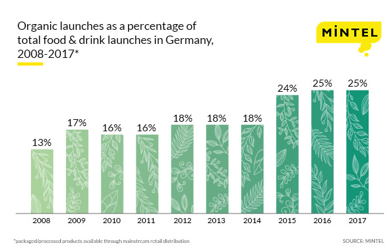
A quarter (25%) of all food and drink products launched in Germany in 2017 carried organic claims, according to Mintel. Organic launches have grown steadily over the past ten years in Germany, increasing 291% between 2008 and 2017 and almost three quarters (72%) of Germans would like to have an even wider choice of organic food and drink products where they shop. Research claims that over half of German consumers (54%) say that a primary factor in their purchasing decision is if a product is organic or has organic ingredients (Mintel, 2018).
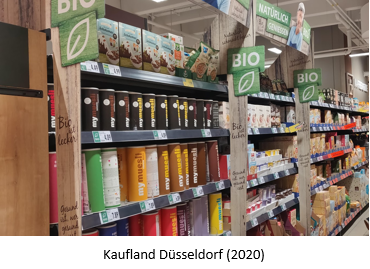
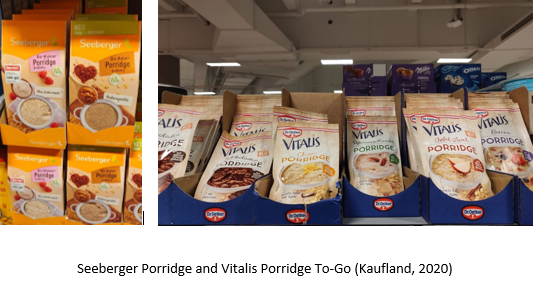
Growing consumer concerns for food safety, the natural environment and their overall health are also fuelling demand for organic products, leading to increased use of organic certification labels in German food and drink launches. 58% of Germans who buy organic food and drink claim to do so because these products are GMO-free. For over half of consumers (54%), the fact that organic food and drink products do not contain pesticides and chemicals is an important factor (Mintel, 2018). This is very predominant in the breakfast category as seen by the eye-catching display in Kaufland (above).
Health
The demand for products without added sugar is increasing rapidly. In early 2019, muesli and granola saw robust growth thanks to its image as a healthy option for breakfast. However, the impact of these positive factors gradually faded towards the end of the review period, as the category reached a higher level of maturity and consumers became increasingly concerned regarding the high sugar content in some muesli brands (Euromonitor, 2020). This particularly applies to crunchy muesli variants, which often have a higher sugar content than traditional muesli recipes.
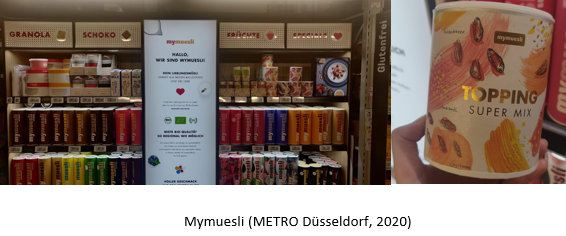
As a result, both branded products and private label ranges are increasingly focusing on reformulation as they seek to reduce their sugar content. An example of this can be seen with Mymuesli. The company is shifting distribution towards major grocery distribution channels, namely supermarkets and hypermarkets, with the company announcing in late 2018 the closure of around 20 of its 50 Mymuesli stores (Euromonitor, 2020).
On-the-Go
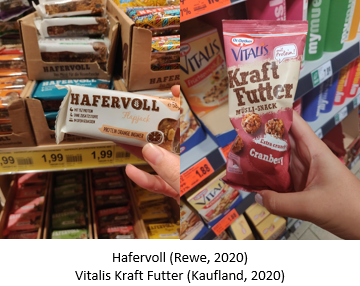
The industry is of course convinced that the market as a whole has plenty of opportunities. At the weekend, there is a trend towards a sociable and extensive breakfast/brunch and during the week, to-go is a topic that is growing more importance. There are definite signs of people enjoying breakfast on their commute to work with products such as Hafervoll (oat bar) and Kraft Futter (muesli bites) gaining space in the breakfast aisles (Lebensmittelpraxis, 2020).
Oats and Porridge
There is a real trend developing towards old classics such as oat flakes and porridge developing in the German market. This development goes hand in hand with the return of traditional breakfasts.A growing demand for porridge is still relatively small and not yet mature, however it is forecasted to be the strongest performing category to come. Thanks to the clean label recipes of porridge, these products increasingly appeal to consumers seeking more natural ingredients, with a growing number equating health with less processed and more natural food.
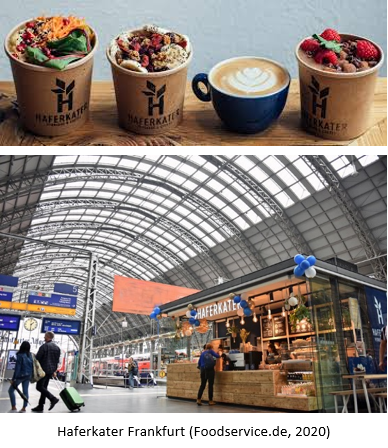
The tendency towards hot cereals such as porridge and on-the-go breakfast consumption is also echoed in the growth of quick service breakfast chain, Haferkater (Oat Hangover). Haferkater make fresh to-go porridge several times a day with toppings such as apple sauce and cinnamon to superfoods such as goji berries and cranberries (Foodservice.de).
What can Irish suppliers learn from trends on the breakfast table?
The breakfast category in Germany is performing well with increases in value and volume seen in 2019. Health and wellbeing continue to drive the direction of the category as muesli and granola begin to lose their health image over sugar concerns while porridge and functional breakfast toppings are now gradually growing in popularity. Irish producers should keep an eye on opportunities such as granola / oat bars and pocket porridge sachets as the Germans move towards enjoying breakfast on-the-go.
References:
Euromonitor: Passport (2019). Breakfast Cereals in Germany
Foodservice.de (2020). Haferkater: Jetzt auch am Frankfurter Hauptbahnhof. Available at: https://www.food-service.de/storechecks/Jetzt-auch-am-Frankfurter-Hauptbahnhof-932
Kaufland (2020). Category Store Audit. Anne-Marie Kelly
Lebensmittelpraxis (2020). Wachstumsfeld Frühstück. Available at: https://lebensmittelpraxis.de/mopro/27842-mopro-wachstumsfeld-fruehstueck.html
Mintel (2018), ORGANIC LAUNCHES GROW STEADILY OVER THE PAST 10 YEARS IN GERMANY. Available at: https://www.mintel.com/press-centre/food-and-drink/organic-launches-grow-steadily-over-the-past-10-years-in-germany
REWE (2020). Category Store Audit. Anne-Marie Kelly