

Confinement & Deconfinement: looking at life inside Spain as a result of Covid 19
With one of the worst outbreaks of Covid 19 in Europe and one of the strictest lock downs, our validators for Spain show some behaviours that are more particular to the Spanish experience.
Understanding these are important, as a market of significant priority to Ireland in the context food and drink exports which was valued at €262m in 2019.
Very limited access to the outside world meant an even greater emphasis on life indoors for the Spanish consumer.
Unsurprisingly engagement with cooking and food was very high.
In their normal busy day to day lives more than 60% of people in Spain consider convenience meals a good substitute for home cooked meals, especially when time is limited people (Periscope 2018). During lockdown however, the Spanish were able to re-engage in cooking some more with 39% of people cooking from scratch.
Not alone that, but 36% are learning to cook using recipes and 20% are following cooking apps and using websites, which is high relative to other markets, highlighting perhaps the importance cooking played as a recreational activity while confined.
Given the restrictions, exercise has been somewhat challenged and presented some polarising findings. While 30% are following an exercise routine, 20% are doing it less now and while 19% are walking jogging or running more, 43% are doing it less now.
However 74% expect to follow an exercise routine more in the future and 66% expect to walk, jog and run more in the future, so this truly highlights the likely restricted nature of lockdown behaviour.
Equally well, a rise in consumption of snacks and treats and baking again all presenting high numbers in Spain will likely encourage people to get active once more. During lock down 29% are having snacks and treats and 33% are snacking outside regular meal times. But in both cases there is a drop off in the number who will do so more often in the future.
Periscope (2018) highlighted how virtually all Spanish adults claim to have a diet that consists of a lot of protein, fruit and vegetables while 9 in 10 claim to eat high fibre foods and tend to avoid sugary foods/sweets, so again this highlights the likely temporary nature of this treating behaviour.
An emphasis on family was the order of the day with 71% having quality time with family and 83% expecting to continue to do so after Covid 19. Eating often being at the heart of this with 39% eating with family more and 29% choosing familiar favourites. Baking became a significant activity, again highlighted in our indicator work as a nice interactive and engaging family activity.
Given the extent of the virus, the Spanish actively took extensive precautions which are demonstrated in particular in the context of protective clothing, contactless payments, online shopping and eating out.
88% of the Spanish are wearing a mask when doing the household shopping and 86% are also wearing gloves when doing shopping for the household which is more extensive than elsewhere.
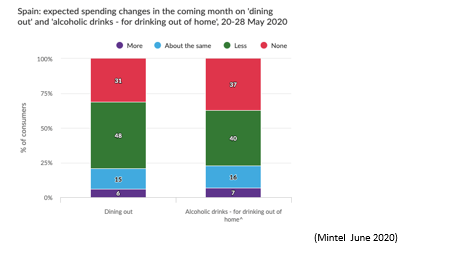
Early Covid 19 Mintel research has shown that going out for a meal or drink was among the activities the Spanish were most looking forward to, however as restaurants and bars allow people return, spending intentions for food service appear low, possibly highlighting peoples concerns about the virus spread, according to Mintel.
Contactless shopping is also particularly high in Spain relative to many European countries. Over half (53%) of Spanish adults are using contactless card payments more now since Covid-19 restrictions, and this behaviour is likely to continue strongly post pandemic.
71% are minimising trips to the store and 41% are grocery shopping on line, and 67% expecting to continue after. This could suggest a change to the future retail landscape.
While deconfinement has brought heightened anxiety about exposure to the virus it has also raised concerns around the economy itself – 65% of all Spanish consumers believe the outbreak will have a significant impact on employment as Spain see its highest ever increase in unemployment for the month of May. 48% of consumers believe that they are worse off than at the start of the virus (Mintel June 2020) 45% of Spanish are now saving for a rainy day now and 83% expect to continue to do so in the future.
With concerns around the virus, the Spanish have also demonstrated an increase in concerns around their health with 41% trying to improve their health generally.
A sizeable proportion of Spanish adults have been actively engaging with better eating as a result of Covid-19 with 32% eating healthier for improved immunity. It’s interesting to note how this is playing out in the context of what they are looking for in food with 19% cooking fish/seafood/shellfish for its known health benefits and 68% expecting to continue to do so in the future. This may also play out in terms of quality associations and food types. More Spanish adults have been buying better quality beef than cheaper beef as a result of Covid-19 restrictions (17% are buying better beef more often compared to 10% buying cheaper beef more often).
According to Mintel 31% of all adults are now also prioritising the environment, particularly 16-24s who are now seeing the environment as a high priority. 26% of Spanish consumers are reducing their food waste with 75% expecting to do more to do more so in the future.
So are we likely to see these behaviours stick according to our validators?
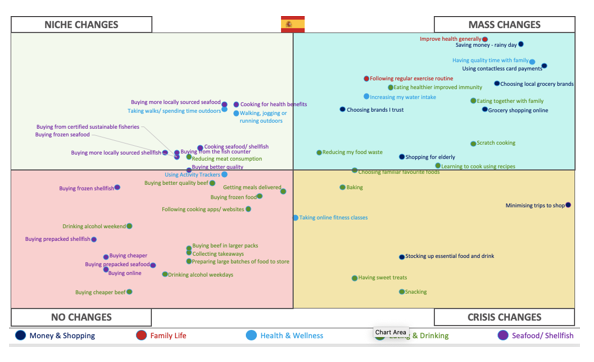
It is likely that health will remain a firm priority for Spanish consumers as they manage the virus and eating for improved immunity combined with exercising, will be key to this.
With a renewed focus on food and cooking, quality is certainly likely to be of importance and buying brands they trust. Managing food waste is also a positive fall out from this.
Considerations for Irish food and drinks business:
- Focus on quality foods and inherent health benefits especially for seafood and beef
- Healthy snacks
- Waste less and enabling food go further as a way to demonstrate value beyond price
- Improved shelf life of produce
- Use of brand marks to create confidence and trust
- Providing recipe ideas to engage consumers
For more on the Spanish indicators click below: