

‘Feeling the Pinch’ Alerts Vol.1
25th September 2020
Grace Binchy, Insight & Trends Specialist, Bord Bia – The Irish Food Board
Every month, Bord Bia’s Thinking House, in collaboration with research partners Canvas8, will bring you the latest insights surrounding recessionary behaviours and sentiments impacting people globally. Each issue will cover a key theme related to people’s response to the recession and the different ways they are spending, saving, eating and drinking as they navigate this financially unstable time.
Volume 1 theme:
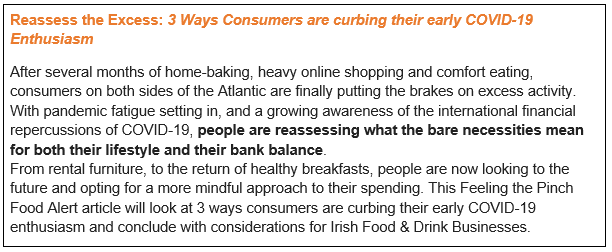
‘Reassess the Excess’ Three key highlights
1. Financial Implications: Irish Shoppers Forgo Pricey Purchases Amid Uncertainty
The number of people willing to spend money on expensive items is steadily falling. Due to COVID-19 uncertainties and economic fears, households in Ireland are on edge about making big investments in these turbulent times.
Couple this with tougher coronavirus restrictions and fears that the virus is on the rise once more, spending is unlikely to go back up for a while. According to the Bank of Ireland Economic Pulse, just 21% of consumers in Ireland thought August 2020 was a good time to spend money on major goods such as furniture and electrical equipment, down from 25% in June. “The rise in virus cases at home and overseas has rattled nerves,” says Dr. Loretta O’Sullivan, the bank’s group chief economist. The uncertainty has also meant many are expecting their household income to continue to fall (Bank of Ireland, 2020)1.
With the potential of further job losses and lockdowns, people are starting to make significant lifestyle changes to how, and what, they spend their money on. Instead of splashing out on big-ticket items, hesitant consumers are likely to seek more budget-friendly alternatives, such as in-home entertainment and product rentals. Schemes such as Selfridges’ HURR collaboration and John Lewis’s rental furniture allow people to enjoy expensive products without the guilt of paying for them in full. With Christmas on the horizon and 23% of Irish consumers worried about their savings depleting, no doubt people will seek comfort from little luxuries rather than the more extravagant purchases they may have been used to in the past (Bank of Ireland, 2020)2.
2. Enough On Their Plates: Britons Scale Back On Lockdown Comfort Meals
At the start of lockdown, many Britons opted for comfort over convenience, with leisurely morning fry-ups making their way back to the breakfast table. But as anxiety and novelty wear off and health concerns gain traction, they’re looking to take stock of their waistlines and early-morning indulgences.
On-the-go cereal bars took a backseat over lockdown, with 89% of breakfasts eaten at home. Kantar data shows that the number of Britons opting for traditional breakfast staples such as bacon and/or eggs was up an extra 82 million occasions compared to 2019. Interest in meals chosen to control calorie intake fell by 28%, while purchases of breakfast 'treats' such as chocolate spread and pastries rose by 40% and 25%, respectively. However, after several months of swapping health for hedonism, “consumers are now picking more breakfast foods for being lower in fat, salt, or sugar with 27 million (7%) more servings,” says Katie Spry, Kantar analyst (William Reed, 2020)3.
With more time spent at home, the kitchen cupboard has been a source of comfort (Canvas8, 2020)4, with some negative consequences: almost half of Britons reported gaining weight during lockdown (The Economist, 2020)5 and 24% cite comfort-eating as the reason (PR Newswire, 2020)6. However, as people adjust to life in lockdown, and the links between obesity and COVID-19 become more apparent, a return to healthy eating is a necessary step in the public consciousness, with 41% of Britons expressing a desire to switch up their eating habits (The Guardian, 2020)7. Still, 51% of consumers admit they have found it hard to stay healthy during the pandemic – food brands that are able to bridge the gap between comfort and well-being will resonate (William Reed, 2020)8.
3. Rethinking Cooking Habits: Americans Culinary Gusto Wanes As Fatigue Sets In
From baking bread to experimenting with vegetarian options, the pandemic saw Americans take a greater interest in culinary creations, but as pandemic fatigue sets in, many are losing their appetite for cooking. Fed up with extensive meal prep, there’s a demand for brands to simplify home-cooking.
When dine-in restaurants had been closed and supermarket trips were limited, Americans were cooking for themselves more than ever, making an average of nine meals a week. Initially, many found a certain deal of joy in their culinary pursuits (Canvas8, 2020)9. However, kitchen enthusiasm is waning: 55% of Americans report feeling fatigued by cooking. Time spent in the kitchen stands out as their main pain point: 69% wish they could make a healthy meal more quickly, while the average person would like to spend just 12 minutes preparing a delicious healthy meal. "Now that Americans are spending an increased amount of time at home, dinner solutions that are nutritious, delicious, and easy to prepare have become a priority," says Justine Kelly, executive chef at Sun Basket (New York Post, 2020)10.
As the pandemic shows little sign of easing, Americans' cooking fatigue may well be a reflection of a much wider fatigue with the pandemic as a whole, which has disrupted daily lives since March 2020. A survey in mid-July showed 73% of adults viewed the pandemic situation as worsening – the highest level of pessimism recorded since Gallup began tracking that assessment in early April (Gallup, 2020)11. "Part of the frustration and disappointment and depression, frankly, is because of the expectation that we’d be through this by now," says John Barry, epidemiological historian (Washington Post, 2020)12. As Americans struggle with pandemic fatigue, brands can play an important role in making their daily lives a little easier, starting in the kitchen. Kraft’s Meal Hero app, for example, uses AI to personalize and simplify meal-planning.
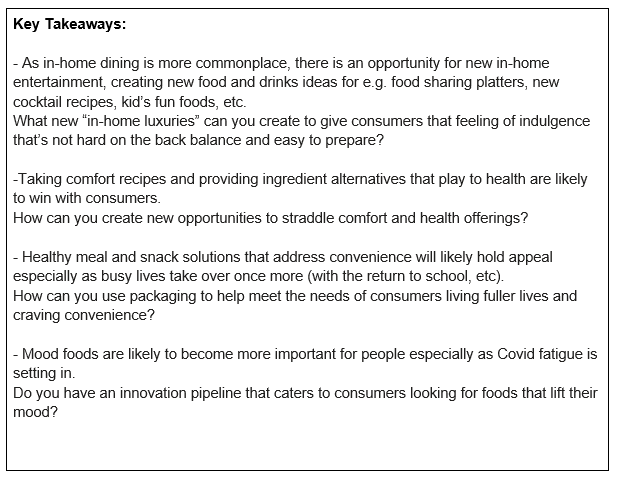
What does it mean for Irish Food and Drinks Businesses?
'Bord Bia's Feeling the Pinch Study which examines six key markets will be published in the first week of November'.
References:
1. Bank of Ireland, 2020. Economic Pulse. August 2020. [online] Bank of Ireland. Available at: <https://www.bankofirelandeconomicpulse.com/pdf/2020/august/economic/full.pdf> [Accessed 17 September 2020].
2. Bank of Ireland, 2020. Bank Of Ireland Survey Reveals Change In Consumer Habits During Covid-19. [online] Available at: <https://www.bankofireland.com/about-bank-of-ireland/press-releases/2020/bank-of-ireland-survey-reveals-change-in-consumer-habits-during-covid-19/> [Accessed 17 September 2020].
3. William Reed, 2020. The Big Breakfast: Breakfast Category Report 2020. [online] William Reed. Available at: <https://www.thegrocer.co.uk/category-reports/the-big-breafast-breakfast-category-report-2020/647139.article> [Accessed 17 September 2020].
4. Canvas8.com. 2020. UK Finds Culinary Comfort In Family Favourite Meals. [online] Available at: <https://www.canvas8.com/signals/2020/07/14/pandemic-meals.html> [Accessed 17 September 2020].
5. The Economist. 2020. Britons Are Defrosting Decades-Old Diets. [online] Available at: <https://www.economist.com/britain/2020/07/11/britons-are-defrosting-decades-old-diets> [Accessed 17 September 2020].
6. Plan, T., 2020. The UK Lockdown Diet Report: Brits Struggling As They Pile On The Pounds, Reveals The 1:1 Diet By Cambridge Weight Plan. [online] Prnewswire.co.uk. Available at: <https://www.prnewswire.co.uk/news-releases/the-uk-lockdown-diet-report-brits-struggling-as-they-pile-on-the-pounds-reveals-the-1-1-diet-by-cambridge-weight-plan-810594872.html> [Accessed 17 September 2020].
7. The Guardian. 2020. Obesity Is A Major Risk Factor For Dying Of Covid-19. We Need To Take It More Seriously | Kermit Jones. [online] Available at: <https://www.theguardian.com/commentisfree/2020/jun/15/obesity-is-a-major-risk-factor-for-dying-of-covid-19-we-need-to-take-it-more-seriously> [Accessed 17 September 2020].
8. William Reed, 2020. The Big Breakfast: Breakfast Category Report 2020. [online] William Reed. Available at: <https://www.thegrocer.co.uk/category-reports/the-big-breafast-breakfast-category-report-2020/647139.article> [Accessed 17 September 2020].
9. Canvas8.com. 2020. Americans Find Joy In New Cooking Discoveries. [online] Available at: <https://www.canvas8.com/signals/2020/04/21/cooking-creativity.html> [Accessed 17 September 2020].
10. New York Post. 2020. Americans Are Starting To Get Sick Of Cooking At Home. [online] Available at: <https://nypost.com/2020/08/20/are-americans-fed-up-with-making-their-own-meals/> [Accessed 17 September 2020].
11. Gallup, I., 2020. U.S. COVID-19 Outlook Deteriorates As Infections Spike. [online] Gallup.com. Available at: <https://news.gallup.com/poll/316202/covid-outlook-deteriorates-infections-spike.aspx> [Accessed 17 September 2020].
12. Washington Post. 2020. With No End To The Pandemic In Sight, Coronavirus Fatigue Grips America. [online] Available at: <https://www.washingtonpost.com/health/with-no-end-to-the-pandemic-in-sight-coronavirus-fatigue-grips-america/2020/08/10/a959424c-d7fa-11ea-930e-d88518c57dcc_story.html> [Accessed 17 September 2020].