

Food Trend Implications of the Doughnut Economic Model (Amsterdam)
As people have steadied into lockdown life, the recurring question raised has been what shall the 'new normal'[1] look like post-crisis? Some are suggesting that handshakes shall become redundant and that businesses shall lower operation costs by hiring remote workers and closing down office space. While these potential changes have significance, the rollout of these changes could be varied depending on the industry, market location and company capabilities.
The city of Amsterdam, on the other hand, has taken a far-broader approach that shall transform its current economic model into the doughnut economic model. Given that around 1.6 million live in and around the city, and that there appears to be a global appetite for change, the ramifications and success/failure of this experiment could be momentous.
What is the Doughnut Economic Model?
"Today, we have economies that need to grow, whether or not they make us thrive; what we need are economies that make us thrive, whether or not they grow." (Raworth; 2017)
Kate Raworth created the doughnut economic model in her book; Doughnut Economics: Seven Ways to Think Like a 21st-Century Economist. The book was published in 2017 and derived part of its credibility from the fact that economics failed to predict the 2008 financial crisis. Modelled around the sustainable development goals, it proposes a 'regenerative and distributive economy' with the central premise that economic activity should be about meeting the core needs of all but within the means of the planet. The overall target is to remain within the doughnut (green space- diagram) and evade suffering shortfalls, such as food shortages, nor allow growth to overshoot into threatening planetary boundaries such as environmental collapse.
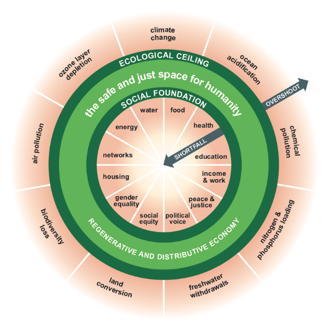
[Image: Environmental Doughnut Infographic; Kate Raworth]
How is this envisioned for the city of Amsterdam?
As of Wednesday 8th, April 2020- the municipality of Amsterdam has begun to embrace this new model, and if followed, policymakers shall start to reward businesses (in effect B corps[1]) that preserve the environment, while also serving the needs of the people.
"We are asking the people and businesses of Amsterdam to take a different approach to food, to change their thinking about possessions and to make different choices in their lives and in their work. The benefits of these changes will not always be noticeable immediately – some may only be so after a few decades – or they will take place on the other side of the world, where many of our raw materials are currently extracted." (City of Amsterdam; 2020)
Amsterdam's model focuses on three priority value chains - Biomass and Food, Construction and Consumer Goods. Guidelines include;
- Encouraging healthy, sustainable and plant-based food consumption by all citizens
- Preventing overconsumption and minimising the use of fast-moving consumer goods
- Circular area development through flexible zoning and regenerative urban design
By assigning more equity to people and the planet, the hope is this new system will support Amsterdam's recovery from COVID 19.
Implications for the food industry
Implementing the doughnut economic model shall mean that sustainability-driven trends and initiatives shall be rewarded and promoted. Some of these trends include;
- A preference for locally and ethically sourced food
Reducing Co2 emissions is part of the strategy report; therefore, the city shall make more of a conscious effort to enable connections between producers of local food and retailers. Further, the city of Amsterdam wants to work with producers who have a transparent supply chain and uphold human rights. This could mean the barring of 'bad actors' from selling or moving their products through Amsterdam ports.
- A preference for food production that supports biodiversity and helps to mitigate climate change.
Such as producers like the Boeren Van Amstel farm group which is a group of 21 farmers committed to preserving and improving the biodiversity in and around the Amstelland area (just outside of Amsterdam).
- Citizens shall be encouraged to grow food (DIY Culture)
This may be seen through the investment of projects like The Amsterdam Balcony Garden Project which helps Amsterdam residents to grow vegetable garden plants with insect and bee-friendly flowers.
- Greater transparency and digital evidencing across the food supply chain
Retailers shall expect authoritative certifications that ingredients are sourced ethically across the food chain so they can present to consumers the authenticity and provenance of a product. Jumbo, for example, has introduced a QR code on the packaging of Tilapia that grants consumers access to its various production processes and journey from Indonesia.
- A preference for products that have waste designed out or repurposed
Companies will be encouraged to utilise biodegradable and informative product packaging (EG Plastic Free certification), such as Dutch chocolate bar company LoveChock. Retailers will also be encouraged to reduce their own waste and take learnings from the likes of Pieter Pot who sell food in reusable glass jars. This transition, however, could take some time, mainly because consumers who may be more price-sensitive or hygiene concerned may favour single-use-packaging.
- Partnerships with local NGOs working to support the environment or feed the vulnerable
Amsterdam is aiming to cut food waste by 50 per cent by 2030. The plan is to reroute surplus food to residents who need it most using organisations like Taste Before You Waste.
- A preference for Vegan and Vegetarian product consumption
Calls that our meat-centred food system is making us sick adds leverage to the health claims of vegan and vegetarian diet advocates. Despite the global attention focusing on China's wet markets, journalists are beginning to highlight that the principal driver of zoonotic diseases comes from broader industrial animal agriculture.
- 'Healthy and Hygienic' ingredients and advertising
Globally, people are concerned about their immune system. "Healthy eating" is remaining the highest priority of food shoppers across Europe currently; therefore, quality assurance marks would be wise to be marketed. This shift in mindset from "live to eat" to "eat to live" means consumers want to feel safe, further, it could be an opportunity for products to evolve using more functional ingredients EG Vitamin D.
Getting ahead of the Next Normal
The fact that the 2 largest food retailers in the Netherlands, Jumbo and Albert Heijn, are reported to be forming an alliance to look at how the Netherlands should emerge from the corona crisis is evidence that leaders in the business community are anticipating a change of standards from across all of Dutch society, not just Amsterdam.
If this model is delivered in the way envisioned, a significant difference in imports and exports can be anticipated in the Netherlands. While this change could present challenges for Irish food producers wishing to enter the market or continue business as usual, companies able to adapt and innovate within the confines of existing solutions could create an opportunity for themselves.
Retailers are likely going to reevaluate their category assortment post-crisis and diversify away from high volume SKUs, so being able to market your product will play a pivotal role in demonstrating its link with local consumer needs.
Irish producers should keep their ear to the ground when thinking about how attitudes are going to change in their target markets; this will support them to consider which capabilities to develop and how to refocus their brand in a way that will remain relevant to consumers needs during and after the crisis.
References
Amsterdam, G., 2020. Met Strategie Amsterdam Circulair In Grote Stappen Naar Een Duurzame Stad. [online] Amsterdam.nl. Available at: <https://www.amsterdam.nl/bestuur-organisatie/college/wethouder/marieke-doorninck/persberichten/strategie-amsterdam-circulair-grote/> [Accessed 20 April 2020].
Boeren van Amstel. 2020. Lees En Kijk Het Verhaal Over De Boeren Van Amstel. [online] Available at: <https://www.boerenvanamstel.nl/ons-verhaal/de-boeren/> [Accessed 20 April 2020].
Boffey, D., 2020. Amsterdam To Embrace 'Doughnut' Model To Mend Post-Coronavirus Economy. [online] the Guardian. Available at: <https://www.theguardian.com/world/2020/apr/08/amsterdam-doughnut-model-mend-post-coronavirus-economy> [Accessed 20 April 2020].
Buck, R., Francis, T., Little, E., Moulton, J. and Phillips, S., 2020. How Consumer-Goods Companies Can Prepare For The Next Normal. [online] McKinsey & Company. Available at: <https://www.mckinsey.com/industries/consumer-packaged-goods/our-insights/how-consumer-goods-companies-can-prepare-for-the-next-normal> [Accessed 21 April 2020].
City of Amsterdam and Circle Economy, 2020. BUILDING BLOCKS FOR THE NEW STRATEGY AMSTERDAM CIRCULAR 2020-2025. Directions for a thriving city within the planetary boundaries. Amsterdam: Circle Economy.
Distrifood. 2020. AH En Jumbo In Alliantie Richting Toekomst - Distrifood. [online] Available at: <https://www.distrifood.nl/ondernemen/nieuws/2020/04/ah-en-jumbo-in-alliantie-richting-toekomst-101133904?vakmedianet-approve-cookies=1&_ga=2.49945766.126194020.1587404700-999371080.1570024605> [Accessed 20 April 2020].
Dore, F., Ehrlich, O., Malfara, D. and Ungerman, K., 2020. Connecting With Customers In Times Of Crisis. [online] McKinsey & Company. Available at: <https://www.mckinsey.com/business-functions/marketing-and-sales/our-insights/connecting-with-customers-in-times-of-crisis> [Accessed 21 April 2020].
Medium. 2020. The Amsterdam City Doughnut: How To Create A Thriving City For A Thriving Planet. [online] Available at: <https://medium.com/circleeconomy/the-amsterdam-city-doughnut-how-to-create-a-thriving-city-for-a-thriving-planet-423afd6b2892> [Accessed 20 April 2020].
nieuws.jumbo.com. 2019. Jumbo Maakt Tilapiaketen Inzichtelijk Met Blockchain. [online] Available at: <https://nieuws.jumbo.com/persbericht/jumbo-maakt-tilapiaketen-inzichtelijk-met-blockchain/464/> [Accessed 21 April 2020].
Readfearn, G., 2020. How Did Coronavirus Start And Where Did It Come From? Was It Really Wuhan's Animal Market?. [online] the Guardian. Available at: <https://www.theguardian.com/world/2020/apr/15/how-did-the-coronavirus-start-where-did-it-come-from-how-did-it-spread-humans-was-it-really-bats-pangolins-wuhan-animal-market> [Accessed 20 April 2020].
SURGE. 2020. Surge | Animal Rights Organisation. [online] Available at: <https://www.surgeactivism.org/covid19> [Accessed 20 April 2020].
Taylor, A., Vettese, T. and Dutkiewicz, J., 2020. The Covid-19 Pandemic Shows We Must Transform The Global Food System |. [online] the Guardian. Available at: <https://www.theguardian.com/commentisfree/2020/apr/16/coronavirus-covid-19-pandemic-food-animals> [Accessed 20 April 2020].
Zhivitskaya, M., 2018. Book Review: Doughnut Economics: Seven Ways To Think Like A 21St-Century Economist | British Politics And Policy At LSE. [online] Blogs.lse.ac.uk. Available at: <https://blogs.lse.ac.uk/politicsandpolicy/book-review-doughnut-economics-seven-ways-to-think-like-a-21st-century-economist/> [Accessed 20 April 2020].