

Food Trend Implications of the Doughnut Economic Model (Amsterdam)
Germany is an important market for Irish food and drinks exports. It wasthe destination for €767m worth of Irish food and drink exports in 2019. Indeed it is the 5th largest destination globally and the 3rd largest in continental Europe. The last five years have seen the value of Irish food and drink exports to Germany grow by 30%, with significant growth in dairy and in alcohol exports.
Consequently, there is significant value in understanding behavioural change that will emerge in the German market as a result of Covid 19 and so Germany represents the 4th edition of our Future Proofing Toolkit series.
As Covid 19 hit Germany a little earlier and as the Germans have come out of lock down slightly ahead, looking at what the German response has been is of interest and hopefully will provide us with valuable foresight around emerging behavioural changes.
Below provides a snapshot of what’s included in this toolkit:
Just under a quarter of Germans are trying to improve their health and wellness and 80% expect to continue to do so in the future (Bord Bia Indicators Barometer) with fitness very much part of this interest in wellness.
According to Mintel, health factors have become particularly important to young adults with many turning to apps and online work outs to help them be more active during a time when gyms are closed and people are spending more time indoors. More than half 16-24s are making exercise a priority and almost 4 in 10 prioritising a healthy diet.
Germans are particularly proactive and responsible when it comes to fighting off the virus.
95% of Germans are wearing masks when doing grocery shopping for their household with 69% wearing a mask for protection and to prevent spread.
It’s interesting to note in a country where “cash is king” over 44% are using contactless payments and 65% expecting to do so in the future.
“Covid-19 has probably changed German payment behaviour faster than any single technology ever has,” says Georg Hauer, general manager of the Germany-Austria-Switzerland region at N26, a Berlin-based online banking start-up. (BBC, May 2020)
During the lock down people have been able to put time into cooking once again. Bord Bia’s Periscope study (2017) would have shown that German consumers were losing their passion for cooking especially mid-week, but one of the upsides of Covid 19 is how it has enabled people be invigorated in the kitchen once more with 25% of people cooking more from scratch and 76% expecting to continue to do more in the future
As people are taking a bigger interest in the food they eat, 51% of consumers are putting a lot of thought into what they eat (Mintel, May 2020). Quality is important here with 13% of German consumers buying better quality beef or better quality cuts of beef and 56% say this is likely to continue into the future.
With German consumers paying more attention to ingredients there is a greater focus on healthier food with 23% eating healthier for improved immunity and 76% expecting to continue to do so in the future.
We are seeing manifestations of this desire for healthier eating emerge across other markets too. According to Iceland’s Trading Director Andrew Staniland they are seeing a decline in frozen ready meals as people have become more time rich and the products used for scratch cooking including proteins and vegetables have seen growth of over a 100% (The Grocer, May 2019)
Catering for family needs in stressful times is also of importance and it’s interesting to see how two German brands have launched a children’s food delivery service to help parents who are struggling during the pandemic. Landwehrstübchen a Frankfurt based restaurant are delivering fresh organic meals that come in compostable organic cups delivered on ebikes, thus delivering a sustainable healthy food solution for families under pressure.
The importance of family has also come to the fore. Over half (51%) of German adults in family life-stages are spending more quality time with their families as a result of Covid-19, a behaviour that there is strong intent to continue post pandemic.
According to Mintel, 38% of adults state that staying in touch with family and friends is of utmost priority to them, followed by healthy eating and the environment.
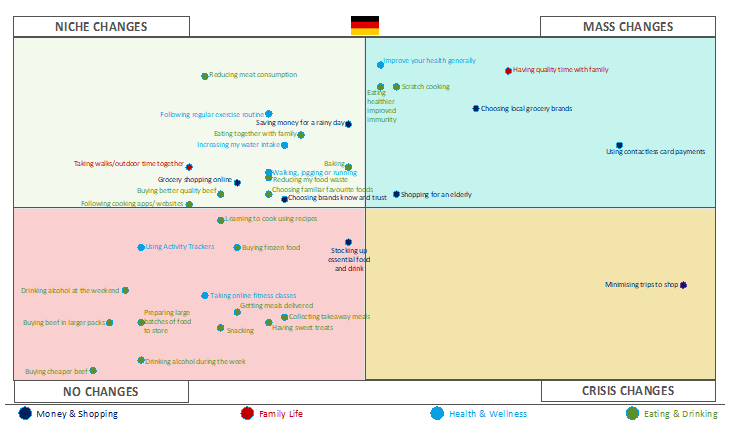
In summary, the below chart highlights the mass changes that are in play that are likely to continue to influence German food behaviour for the future.
The Germans consumer is in particular likely to stay focused on health, seek out foods that address immunity and be more family focused than ever.
Considerations for Food and Drinks Businesses Catering to the German Market
- Food solutions for the young and active who are health conscious
- Packaging solutions that address hygiene concerns
- Family meal offerings
- Healthy convenient solutions
- Underpinning solutions with a sustainable proposition
- Considered and transparent ingredients lists
To find out more about our German Future Proofing Toolkit click here.
Additional Sources:
https://www.bbc.com/worklife/article/20200520-will-coronavirus-change-germans-love-of-cash