

Estelle Alley, Market Specialist, Prepared Consumer Foods & Horticulture, GB Market Bord Bia – The Irish Food Board
UK Economy Outlook & Lockdown
We are currently four weeks into the UK lockdown and are set for another three weeks to 7 May, the UK government announced on 16 April 2020[1]. The entire Food and Drink sector has seen a combination of a significant shock to demand and a shock to supply. From the demand point of view social distancing measures and falling consumer confidence have reduced the willingness and ability of households to spend. On the supply, side employee sickness and value chain disruption have interrupted production and we may well continue to feel the impact of this disruption into the second half of 2020 and 2021. Shoppers will be value focused given the challenging economic outlook.
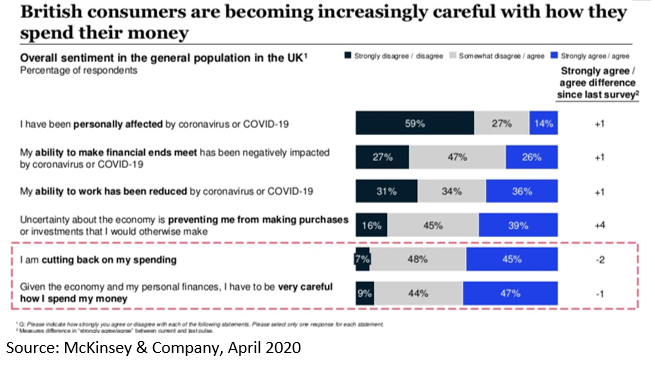
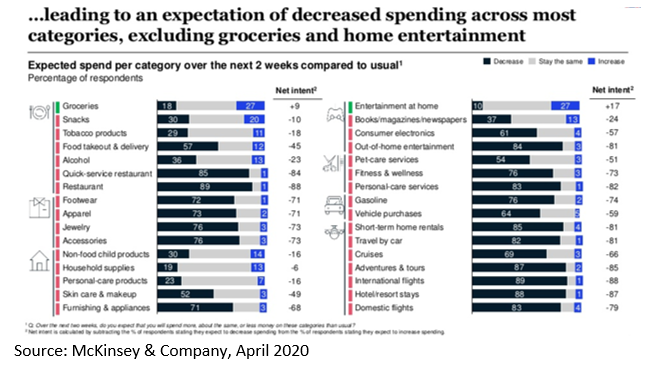
Signs that British consumers are adjusting to the realities of Covid-19 are being reported. From a recent survey by McKinsey & Company[2]on the UK market, it is reported that over the month of April consumers expect a decrease in their income, spending and savings, and may spend less in most categories, though grocery and home entertainment will remain the only categories where expenditure is expected to increase. Consumers are set for what they think will be a long haul before things return to normal. Uncertainty about public health, the duration of the crisis and the health of vulnerable relatives remain top concerns.
Supply Chain Changes in the UK Grocery sector
With the closure of non-essential shops and facilities, amongst which are restaurants, pubs, hotels and schools, UK businesses have had to think outside the box and employ a flexible approach that sees them take advantage of alternative routes to market for their products. There have been many UK cases of such alternative routes to market that I would like to highlight:
UK Multiples & Discounters ramped up home delivery capacity
Online is a costly channel to serve for UK retailers but one that cannot be ignored during this crisis. With the ramp up, for example, Tesco[3] announced in April that they would increase the number of home delivery and Click & Collect slots to 780,000 per week, that's an increase of 120,000 per week from March deliveries, in order to cope with the growing demand for online services. This would involve investment in new infrastructure and human resources, equating to 200 vans, and 2,500 new drivers and 5,000 store pickers respectively. On 17 April Aldi UK[4] launched its online delivery service for food parcels. They were sold out by around 10.20am Day 1. The boxes, which are designed to help vulnerable and elderly shoppers who can't leave their home, cost £24.99 and contain 22 items. These items include soup, pasta, antibacterial hand wash and toilet roll. Shoppers are being limited to one box per week, and the supermarket is asking for priority to be given to vulnerable and elderly people.
Foodservice operators and catering suppliers switch from on trade to off trade
Following the closure of core on-trade outlets (restaurants, bars, pubs) a substantial gap has been left for foodservice and catering supplier which has pushed them to source a new customer base where they can supply their stock such as opening dark kitchens, working with retailers delivering store cupboard essentials and taking the plunge into delivery. Examples include Bidfood & Brakes both making store cupboard essentials available to supermarkets struggling to find enough supply to cope with the demand. Midcounties Co-op retailers[5] have also been working closely with regional wholesalers to ensure consistent supply to rural community shops which is balanced fairly with supply to other business types.
More Suppliers are selling Direct to Consumers (D2C)
Just this week Heinz announced its launch of direct to consumer delivery service called Heinz to Home[6]; offering bundles of beans, spaghetti hoops, and soups sent directly to consumers’ homes. Its aim is to help frontline workers that don’t have time to buy groceries from stores. Bidfood has also setup a direct-to-consumer option on its website, offering a delivery service from its network of distribution depots and a click & collect service from 14 of its sites.
Supply Chain Implications
The IGD[7] have identified supply chain implications that relate to the changes in the UK Grocery sector highlighted.
Since social distancing measures were introduced, many retailers have struggled to cope with the increasing demand for home delivery and Click & Collect services. In these circumstances, retailers would need to be quick in scaling up their existing capacity to meet demand. This may require investment in new infrastructure and human resources, not only to meet the current demand, but also to gain long-term customer loyalty post Covid-19. Suppliers should be planning and investing in online marketing strategies to convert new shoppers.
We have seen UK retailers put strict measures put in place around SKU rationalisation and reducing promotions. Operational efficiencies for them will be front-of-mind coming out of the crisis, and we cannot expect retailers to fully reverse course in relation to some of these measures. Consider the implications for your business.
Finally, the pandemic has paved the way for new relationships between foodservice and retailers. Though it may seem that current joint efforts are circumstantial, these could open the door to lasting relationships that were not likely to be established before Coivd-19. This could have positive implications for contingency planning going forwards and possibly even everyday supply arrangements.
For the Irish Food & Drink industry exporting to the UK it’s vital to understand how these implications impact your supply chains and to identify key points of risk and pinch points in the short to medium terms as further disruption is anticipated. Update UK Customers on your Covid-19 response planning much like you would have done in Brexit planning to show preparedness, agility, flexibility and the resilience of your supply chains.
A John F. Kennedy quote that I read this week has stayed with me: “When written in Chinese, the word ‘crisis’ is composed of two characters. One represents danger and the other represents opportunity”.
As part of our Covid-19 response Bord Bia[8] have a series of webinars running to help support the industry navigate through these uncertain times; information available on Bord Bia Covid Hub. Please visit www.bordbia.ie/industry/covid-19
UK Market webinar Tuesday 21st April @14.00
I am hosting a UK Market webinar Tuesday 21st April @14.00where I will outline the latest UK economic outlook and impact on trade across retail and foodservice channels plus I will share key insights that the GB team are hearing from UK Customers. I will be joined by Dave Howorth from Scala Consulting who will dive deeper into the supply chain & logistics disruptions that are being reported during the Covid-19 crisis and outline the implications for UK Customers and their suppliers.
To register please click here.
Sources:
[1] The Independent News: https://www.independent.co.uk/news/uk/politics/uk-lockdown-coronavirus-announcement-date-press-conference-when-a9469166.html
[2] McKinsey & Company: https://www.mckinsey.com/business-functions/marketing-and-sales/our-insights/survey-uk-consumer-sentiment-during-the-coronavirus-crisis
[3] The Grocer https://www.thegrocer.co.uk/online/tesco-announces-massive-increase-to-online-delivery-slots/603523.article
[5] COOP News: https://www.thenews.coop/147000/sector/retail/co-ops-and-covid-supply-chain-issues-for-small-or-remote-stores/
[6] Heinz 2020: https://heinztohome.co.uk/
[7] The Institute of Grocery Distribution www.igd.com
[8] Bord Bia: www.bordbia.ie/industry/covid-19