

Fintan Ryan, Bord Bia Fellow Korea, Bord Bia - The Irish Food Board
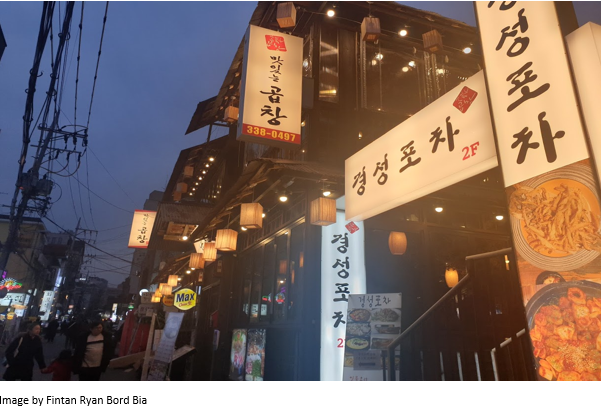
When one scratches the surface of Korea, it is immediately apparent that it is a culture centered around food. Indeed, instead of asking ‘how are you?,’ in the Korean language, the most frequently deployed phrase is ‘have you eaten yet?’ This is not to say acquaintances are actually interested in when you ate last, but it is instructive that in inquiring about someone’s wellbeing, Korean people ask about how full your stomach is, rather than the status of the heart or the mind. There is a strong cultural implication that to have not eaten in a few hours, is to be having a bad day.
This carries through to food consumption habits in Korea, where like their near neighbours Japan, a snacking culture predominates - and convenience is the order of the day. Apart from the ubiquitous convenience stores on every corner of every street, Korea has a highly evolved app-based food- delivery eco-system. Long before Uber Eats or Just Eat took hold in Europe or North-America, scooters were whizzing around Seoul delivering lunches to the desks of hungry salarymen in high rise office complexes.
Korea is an intensely trend-driven food market, what’s hot one month, is most decidedly not the next. For those that have seen the Oscar winning Korean movie Parasite, you may remember that two of the antagonists went broke by being late arrivals to the Taiwanese cake shop craze that briefly gripped the country, and their lives fell apart thereafter.
When assessing food trends in Korea, those skilled at Google Adwords and other SEO tools one might be familiar with in the West might have difficulty targeting consumers. This is because Korea is one of the few countries where Google products and services do not enjoy top-billing. The Korean internet eco-system is dominated by the native search engine giant Naver. Naver is a little bit of Google, a little bit of Reddit (more about Naver’s micro-blog scene later), and a little bit of a news aggregator service, all rolled into one. It’s essentially an all-purpose portal to the internet and unsurprisingly, with food occupying a large slice of the Korean mindspace, food-blogs on Naver are hugely popular.
When one is searching for an eatery in restaurant dense Seoul, hungry patrons will plug in matjip into the Naver blog search bar to look for good food nearby. Matjib essentially means ‘tasty house’ in Korean, and is probably best described as a crowdsourced consensus Michelin star. It is not unusual to see long queues of hundreds of people outside a matjip newly unearthed by a food power-blogger. With an astonishing 83’000 restaurants in the Seoul area (by way of comparison, London has a mere 18’000), the food service industry in Korea is an extremely attractive market for would-be Irish providers of meat, dairy, spirits and other food solutions.
Another food trend that speaks to social change in Korea over the decades is the rise of the term ‘hunbapp,’ which is a portmanteau of the words to eat rice alone. Korea is one of the societies most afflicted with an extremely low-birthrate, low marriage rates and ultimately, a huge rise in individuals living alone (one quarter of all households are single-person as of 2019); which in turn, has increasingly transformed in-home Korean food consumption from being a social and communal family activity, to a solitary one driven by individual choice. The traditional Korean meal context is that food is to be enjoyed together, and the act of breaking bread among family and friends is to share both life’s challenges and joys. So, to eat alone as many young Koreans now regularly do would have once been a slightly embarrassing and shameful exercise. TV shows such as Na hunja sanda (translation: I live alone), which feature celebrities who live alone, have helped young Koreans come to terms with and even celebrate the freedom of enjoying one’s own company, and to practice hunbapp proudly.
Korean delivery services have made hay from this trend, with the three main delivery apps: Baedal, Minjok and Yogiyo seeing transactions double from the start of 2018 to a figure US-$520m in the month of July 2019 alone. It is particularly noteworthy that three-quarters of all users of these services are in their 20s and 30s.
Conversely, the three biggest supermarket chains; Homeplus, E-Mart, and Lottemart are struggling to keep up. Lotte Shopping, the retail arm of the giant Korean conglomerate Lotte, announced in January that they intend to close 200 stores nationwide in the face of challenges from online competitors. Many Lottemart supermarket outlets are expected to be among the casualties.
Korea is a society that is undergoing a profound transformation from a country that was one of the breakout economic stars of the 20th century, to one that will have to come to terms with an ageing population (by 2050, it will be the 3rd oldest society in the OECD group of developed nations). Its food culture and food industry is scrambling to keep pace with these changes. What will remain constant, is that Korea will remain a wealthy nation and it will retain its obsession with food. Food solutions providers that can harness the individual tastes of a sophisticated foodie nation, and successfully provide for the needs and wants of consumers in the healthy-ageing space stand to do well.
For ambitious exporters that get Korea right, the size of the prize is large – the average household spend on food and beverages is estimated at over 4’300 euro per-annum (2016). Perhaps it’s time more Irish food companies started asking Koreans ‘have you eaten yet?’
Sources:
Japan & South Korea Cultural Context & Pathways Model – Bord Bia (2019)
The Food and Beverage Market Entry Handbook: South Korea – European Commission (2019)
‘Lotte Shopping to close 200 outlets after reporting near $1 bn net loss for Q4’ – Pulse by Maeil Business News (Feb. 2020)
‘Orders at Korea’s top 3 food delivery apps double in less than 2 years’ – Pulse by Maeil Business News (Sep. 2019)
Seoul city profile – World Cities Culture Forum – BOP Consulting (2020)