Kudos for Casein – The Protein Powder That Packs a Punch
Margaret Butler, Manager Dairy Ingredients, Bord Bia – The Irish Food Board
31st August 2020
Ireland is renowned for its production of superior quality, highly functional, grass fed dairy products. That reputation extends itself to Casein and Caseinates; two protein dense, value adding and highly functional dairy products of which Ireland is one of the most technically dexterous and advanced producers in the world.
Casein
Ireland is the second largest exporter of Casein in the world.
In 2019, Irish exports topped 55,000mt reaching 50 counties, just behind New Zealand’s export total of 57,000mt.
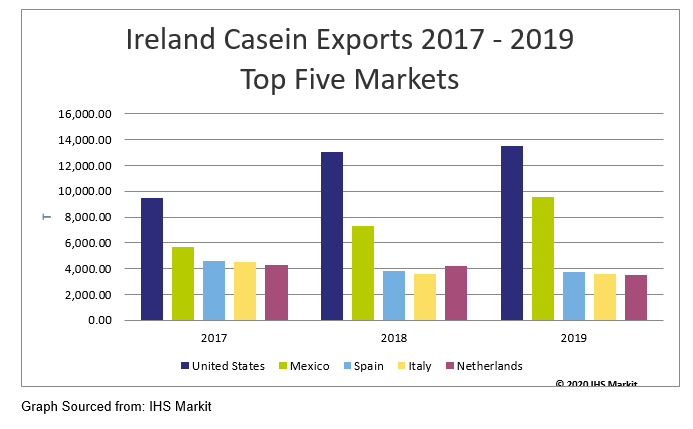
The US, Mexico, Spain, Italy and the Netherlands are our main export partners and between them last year accounted for close to 65% of all Irish Casein exports (refer graph 1).
Essentially, Casein is a protein dense powder and as a dairy ingredient is mainly utilised for that high protein content and emulsification properties which lend to various functional applications including; the production of analogue cheese mainly for pizza toppings, yoghurts, liqueurs, bakery/confectionary, pharmaceutical and sports nutrition products.
Its functionality and popularity in sports nutrition products is justified owing to its slow digesting properties that counter the catabolic (deterioration) effect on muscles. The multi-functionality and benefits of Casein also extend to glazes for baked goods as well as texture and binding properties in confectionary products.

Casein is also widely used in non-consumable and textile products including adhesives, plastics and cosmetics.
The two main Casein specifications are Acid and Rennet Casein and both are derived from pasteurised skimmed milk and distinguished by either the addition of an acid or a rennet enzyme.
Caseinate
From Acid Casein, Caseinate can be produced which in effect is a neutralised protein powder, neutralised owing to the addition of an alkaline ingredient, such as sodium hydroxide. As distinct from Casein, Caseinate is soluble in water and therefore has wide ranging functionality as a dairy ingredient including; viscosity, temperature stability, emulsification and with a typical composition of 90%, is an excellent protein source. Applications for Caseinate are manifold and include; coffee creamers, milk replacer, meat products, soups, salad dressings and nutritional food and beverages.
Calcium Caseinate is produced by adding a calcium compound, typically calcium hydroxide. In so doing, functionality and application extends to whitening and dispersability, desirable functions for the production of coffee creamers, milk replacers and deserts as well as adding mineral fortification.
While New Zealand is the largest Caseinate producer by far and exports in excess of 30,000mt Ireland is the third largest, exporting approximately 2,200mt in 2019 the lion’s share of which was exported to Netherlands, Denmark, Germany and United Kingdom
For the first five months of 2020, the value of Irish Casein exports has increased over 36% to €122.9 million and in volume terms is on par (18,000mt) with the same period last year.
Casein and Caseinates are grouped amongst the more high value dairy ingredients and powder products owing to both their functional and chemical composition. However both are subject as all dairy ingredients tend to be, to price volatility and market dynamics.
Our industry’s agility to navigate what has been a very challenging year for dairy ingredients has manifested in a 4.7% volume increase in total exports for the period January to June and a value increase of 7.8% versus that of the same period last year. With respect to Casein, the Euro value differential year on year is +35% or €159.4 million.
Although the first half of 2020 has been positive in terms of year on year export activity for Irish dairy ingredients including Caseins, it’s probable that the impacts of Covid-19 have not yet fully materialised and by and large, there remains ambiguity surrounding dairy markets and demand for the second half of the year.
Solid, knowledge-based relationships between our dairy exporters and global customers will remain key differentiators for Irish dairy ingredients into the future.