

Milk Alternatives in Sweden: The Rise of Oat Milk
Sweden is a country that has traditionally had high levels of dairy consumption. Butter, cheese and milk are all considered essential components of a conventional Swedish breakfast and other meals throughout the day. More specifically, the consumption of milk in Sweden has always been relatively high, with their per capita consumption of 130.5 l/yr being ranked as the second highest in the world in 2007, only topped by their Finnish neighbours.
Nevertheless, this figure has steadily decreased in recent years, with milk consumption per capita experiencing a significant drop down to 98.2 l/yr in 2018. The main reason for this sudden fall in milk consumption is a change in its consumer perception; from being perceived as healthy and even ‘nature’s sports drink’ (as promoted by Arla) to now raising concerns regarding its health benefits and environmental impact.
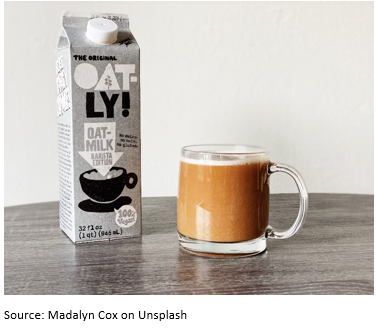
According to Goldberg (2019), the main trigger for this shift was the entrance of the plant-based milk alternative producer ‘Oatly’. While this company was founded in 1994, they broke onto the scene in 2014 after a series of marketing activities that took the Swedish milk industry by storm. These mainly included packaging messages, but also YouTube ads and event sponsorships questioning the health benefits and environmental sustainability of cow milk. Examples of this include the slogans ‘it’s like milk but made for humans’ and ‘wow, no cow!’.
Following Oatly, other brands such as ‘Sproud’ & ‘Oddlygood’ entered the market, increasing the competition in this sector and continuing to take from dairy companies’ market share. In addition, certain plant-based milk brands have become popular not only in Sweden, but also in global trend-setting markets such as the USA. In 2018, Oatly established a 15-million-dollar production site in New Jersey which has been very successful to date, while Sproud is set to enter this market in the coming weeks. The same way Oatly has become a leader in the oat milk category, Sproud is hoping to do so in the pea protein segment.
With the growing presence of milk alternatives, and their influence on consumers, what once was a niche buying group has evolved into mainstream. In 2008, milk alternatives were mostly demanded by lactose intolerants and the number of vegans that, at the time, made up a small slice of the market. However, the rise of the vegan diet, as well as the degraded image of dairy in terms of health and environmental impact, has launched milk alternatives onto the mainstream market.
With these elements in mind, it is important to consider whether the claims being made by companies like Oatly are accurate. The Swedish Dairy Lobby obviously did not think so as they sued Oatly in 2015 and won the case. Consequently, Oatly were forced to stop referring to their products as ‘milk’, as well as stop downgrading the health benefits and suitability for human consumption of cow milk. However, according to Goldberg (2019), this victory backfired, as Oatly published the details of the case and made it seem like the Swedish Dairy Lobby were bullying the small oat milk producer. As a result, Oatly experienced a sharp increase in sales which contributed to their success today.
Judging this rivalry from a health standpoint, it is worth noting that cow milk contains more total nutrients and naturally occurring nutrients than oat milk. At the same time, cow milk has roughly double the amount of protein compared to oat milk and most of the other non-dairy options. For this reason, people that benefit from these nutrients and switch to a plant-based alternative would likely need to compensate for this loss of nutrients. Nevertheless, there is a small percentage of the population that experience lactose and milk protein intolerance. This, combined with the release of numerous but yet-to-be proven studies claiming negative health effects of milk (such as acne in teenagers), are two of the main reasons for the decrease in popularity of cow milk.
Although there is no scientific proof that oat milk and other plant-based alternatives are superior to cow milk, dairy multinationals like Arla Foods were left with no other option but to re-define their strategy and enter the oat milk segment. This demonstrates that, while Arla still remains the market leader, companies like Oatly are driving the latest consumer trends in the Swedish market
References:
Bratthall, E., 2012. Mjölk – Naturens Egen Sportdryck. [online] Arla. Available at: <https://www.arla.se/om-arla/nyheter-press/2012/pressrelease/mjoelk-naturens-egen-sportdryck-1125608/> [Accessed 2 April 2020].
Caporuscio, J., 2019. Almond, Hemp, Oat, Soy, And Cow's Milk: Which Is Best? [online] Medical News Today. Available at: <https://www.medicalnewstoday.com/articles/325425#hemp-milk> [Accessed 2 April 2020].
Chiorando, M., 2020. Farmer 'Sad' As Dairy Giant Arla Launches Oat Milk. [online] Vegan News, Plant Based Living, Food, Health & more. Available at: <https://www.plantbasednews.org/lifestyle/farmer-sad-dairy-giant-arla-oat-milk> [Accessed 2 April 2020].
Franklin-Wallis, O., 2019. White Gold: The Unstoppable Rise of Alternative Milks. [online] the Guardian. Available at: <https://www.theguardian.com/news/2019/jan/29/white-gold-the-unstoppable-rise-of-alternative-milks-oat-soy-rice-coconut-plant> [Accessed 2 April 2020].
Goldberg, J., 2019. Sweden’S ‘Milk War’ Is Getting Udderly Vicious. [online] The Outline. Available at: <https://theoutline.com/post/8384/sweden-milk-war-oatly?zd=2&zi=iqirdfiv> [Accessed 2 April 2020].
Kibbe, K., 2019. Sweden Is Waging A War on Oat Milk. [online] Inside Hook. Available at: <https://www.insidehook.com/daily_brief/news-opinion/sweden-is-waging-a-war-on-oat-milk> [Accessed 2 April 2020].
Newhart, B., 2020. Swedish Pea Drinks Make North American Debut. [online] Dairy Reporter. Available at: <https://www.dairyreporter.com/Article/2020/03/16/Swedish-pea-milk-makes-North-American-debut> [Accessed 2 April 2020].
Sawe, B., 2018. Countries Who Drink the Most Milk. [online] World Atlas. Available at: <https://www.worldatlas.com/articles/countries-who-drink-the-most-milk.html> [Accessed 2 April 2020].
Shanker, D. and Rolander, N., 2019. Oatly’S Path To Alt‑Milk World Domination Starts In New Jersey. [online] Bloomberg. Available at: <https://www.bloomberg.com/features/2019-oatly-oat-milk-global-domination/> [Accessed 2 April 2020].
Statista. 2020. Sweden: Per Capita Consumption Of Milk 2008-2018 | Statista. [online] Available at: <https://www.statista.com/statistics/557618/per-capita-consumption-of-milk-in-sweden/> [Accessed 2 April 2020].