

Sean Baird, Bord Bia Fellow, New York
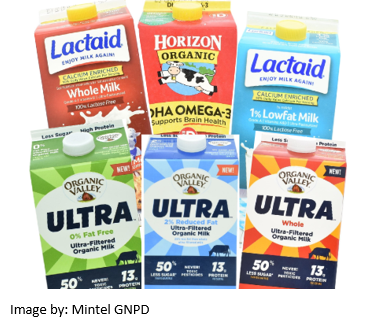
In the last number of years, the non-dairy milk industry has boomed, with projections of the global non dairy milk industry to reach a value of $38 Billion by 2024. (Market Watch, 2020) In the US, dairy is starting to adapt and the industry is beginning to see various variations of milk on the shelves.
The dairy industry is fighting back by using a number of health claims on their packaging. A number of these claims in the past were presumed to be known by the consumer, however now brands are starting to reiterate how valuable a source of nutrition dairy milk is. Some of the claims that brands are singling out to use on their packaging are Low Sugar, Protein, Lactose Free, Benefiting Ageing, Brain and Eye Health, Post Exercise benefits and more.
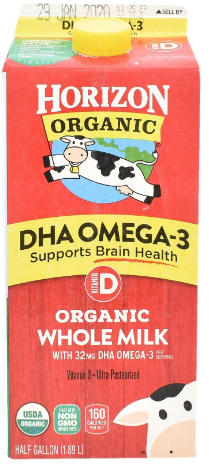
Organic Horizon have a number of milks with health claims, one of their most popular is the DHA Omega 3 Whole Milk which is fortified with DHA Alga Oil, to quote their website – “Give your family the goodness of Horizon® organic whole milk, with 32 mg of DHA Omega-3 per serving. DHA Omega-3 is a valuable nutrient that supports brain and eye health.
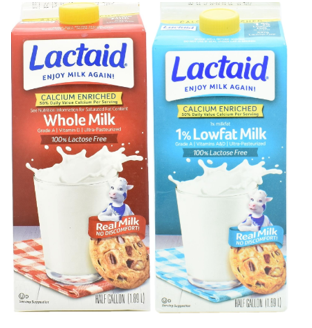
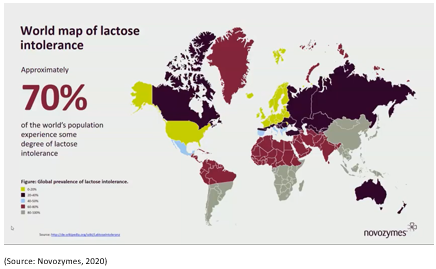
Lactaid are a brand that are using lactase enzyme in their milk product to breakdown to lactose, which then makes their product accessible to everyone. These products are perfectly suited to succeed in markets that have a high level of intolerance to lactose such as South America, North Africa and the Middle East.
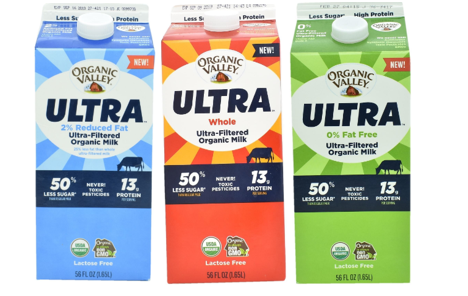
Organic Valleys new ULTRA Milk range has claims of 13g of protein, ultra filtration , and 50% less sugar. The range is said to have 50% more organic protein and 50% less sugar than regular milk and is available in the US in four variants: whole, 2% reduced fat, 2% chocolate, and skim.
The products are made with Organic Valley’s organic milk from the cooperative’s pasture-raised cows. During the filtering process, the naturally occurring sugar-lactose in the milk is reduced. The addition of a lactase enzyme makes the range lactose-free.
The shifting allegiance of younger consumers away from traditional milk has previously been referred to by the former chairman of Dairy UK, David Dobbin, as “a demographic time bomb”. Put simply, plant-based milks represent an existential crisis for traditional dairy; younger consumers look set to continue the move away from dairy milk and thus create a future in which their loyalty to plant-alternatives is propagated while dairy loyalists fade away. (Inside Drinks, 2020)
The question is, what can the dairy industry do to renovate their image and win over both transitioning and new customers alike?
References
Just-drinks.nridigital.com. 2020. Dairy 2.0: Adapting The Dairy Industry To The Changing Market - Inside Drinks | Issue 29 | April 2019. [online] Available at: <https://just-drinks.nridigital.com/inside_drinks_apr19/dairy_20_adapting_the_dairy_industry_to_the_changing_market> [Accessed 10 March 2020].
American Society for Nutrition. 2020. Going Nuts About Milk? Here’S What You Need To Know About Plant-Based Milk Alternatives | American Society For Nutrition. [online] Available at: <https://nutrition.org/going-nuts-about-milk-heres-what-you-need-to-know-about-plant-based-milk-alternatives/> [Accessed 10 March 2020].
Horizon. 2020. Horizon Organic DHA Whole Milk. [online] Available at: <https://horizon.com/organic-dairy-products/organic-milk/organic-whole-dha-omega-3-milk/> [Accessed 10 March 2020].
MarketWatch. 2020. The Global Non-Dairy Milk Market Is Projected To Reach Revenues Of More Than $38 Billion By 2024. [online] Available at: <https://www.marketwatch.com/press-release/the-global-non-dairy-milk-market-is-projected-to-reach-revenues-of-more-than-38-billion-by-2024-2019-03-26#:~:text=> [Accessed 10 March 2020].