

Francesca Perfetto, Market Specialist Milan, Bord Bia – The Irish Food Board
Even at the end of this lockdown, the situation in Italy and in the rest of the world will not be the same, at least not for a while. This pandemic will surely lead to significant changes for the whole food industry: from food production and supply to logistics and sales strategies across the world.
Recent studies and research show the effects of this crisis in the short-medium term: strategic consulting firm Kearney has estimated that between February and May 2020, sales in physical grocery channels in Italy will grow by 5.5%, and online grocery channels will increase by 96%. Some re-adjustment is expected after May (when presumably there will be a partial reopening) for the physical grocery channel, down between 1.5 and 3% (with a decisive shift to more basic products and lower margins), while the online grocery channel will grow between 75 and 90%.
There will be increased demand on ‘essential’ goods, with consumers more sensitive to price, less room for innovation and new product launches, a more local supply chain e.g. Km0, increased digital promotional strategies, and an acceleration of e-commerce.
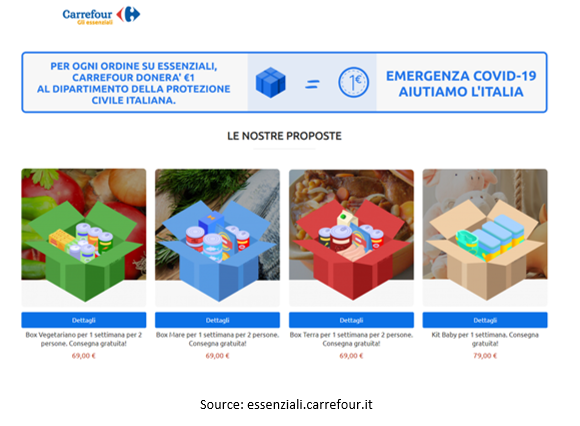
In fact, some retailers in Italy have already moved in that direction offering a valid solution to consumers in this time period. For instance, Carrefour Italia launched a new online service called ‘The Essentials’. Consumers can choose from a series of pre-packaged boxes containing basic food necessities (with vegetables, fish or meat) for 69€ and themed kits dedicated to home cleaning, personal care and/or child products for €79. The boxes will have an expected delivery time of 4 days, and €1 from every box will be donated to support the Civil Protection services which demonstrates the importance of showing solidarity at these times.
The analysis also predicts that if promotional leaflets are banned (which account for 5% of sales in the dominant high/low Italian model), retailers will have to rethink pricing strategies (perhaps considering “every day low price”?), and brands will have to change focus to remain relevant to consumers.
Brand with a focus on ‘wellness’ will benefit, as diet-related diseases are known to increase the risk of death from Covid-19. E-commerce will increase, especially the purchase of low-margin basic products, and delivery and logistical systems will need to be restructured to support this.
In Italy, there was a 20% increase of grocery sales, but very concentrated on primary goods (pasta, preserves, canned goods, hygiene-related products) with less margins. In the meantime, e-commerce food has exploded (+ 52% of supermarket transactions between 8-15 March), with an increase even in fresh food (traditionally very low) and the emergence of a new segment of consumers. Although, the research pointed out that online sales of gourmet food, after an increase in transactions (+ 20%) at the beginning of March, have had a decline: a sign that Italians are becoming more cautious and are starting to feel the economic fallout.
Hence why, the most likely scenario will be a change in consumer sentiment and a reduction in purchasing power. An essential and healthy offer for the consumer would be key to remaining relevant.