

Post-panic shopping, the real effects of Covid-19 on US Grocery Chains
This article seeks to provide a brief insight into what the US grocery marketplace looks like in the wake of Covid-19. The circumstances are continuously changing, they differ depending on each particular grocery chain and vary across each state.
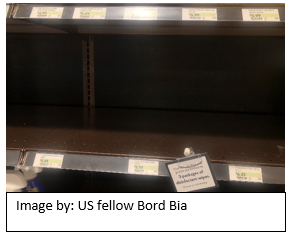
During the months of March and April the expression ‘panic-buying’ was becoming a familiar phrase as consumers began stockpiling groceries for fear of impending lockdown orders. The heightened sense of hysteria was further amplified by images of empty supermarket shelves circulating across social media platforms. This erratic buying behaviour led to a dwindled supply of products across supermarket shelves, as US retailers struggled to cope with the overwhelming demand and the supply chain began to crack under the pressure. Every-day essentials such as milk, bread, meat and flour were sold out in stores leaving consumers with an increased sense of angst and frustration. A large percentage of Americans participated in ‘panic-buying’ as Bord Bia reported that “50% of US adults are now stocking up more on essential food and drink for their homes as a result of the Covid-19 response” (Bord Bia, 2020).
What does grocery shopping look like now?
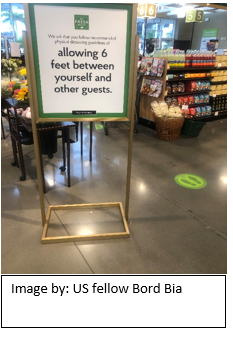
The once routine and momentous chore has now been dramatically altered over the course of the last few months. US shoppers can now expect to be greeted with reduced capacity in store, long queues, compulsory face masks and hand sanitizers. The New York Times published an article offering advice and guidance to shoppers about what to expect in store and what guidelines they should be adhering to. For instance, “some stores have installed wipe and hand sanitizer stations and put colored tape on floors to help customers keep their distance at checkout lines. If your store isn’t taking special measures, don’t shop there” (New York Times, 2020)
What will grocery shopping look like in the future?
Retailers e-commerce and home delivery capabilities have come to the fore-front of their crisis management solutions. Consumers are cutting down or avoiding trips to grocery stores all together, “66% of US adults have minimised their trips to the shop as a result of the Covid-19” (Bord Bia, 2020). Grocery chains offering home delivery resources have provided an essential service for consumers during Covid-19. “One survey found one-third of households said they used online grocery pickup or delivery during the week ending March 13, and 40% of those tried it for the first time” (Wall Street Journal, 2020).
This shift in consumer behaviour has seen a considerable increase in the popularity of online grocery apps such as ‘Instacart’. This online platform promises to deliver groceries, from your local supermarkets, straight to your home in just under 2 hours. For the most part, consumers seem to be pleased with the service, but a key factor for success is retailer’s ability to meet demand along with delivery times and availability slots. It appears Instacart were early to respond to the potential impact of Covid-19 however, “there was still far too little time to adequately corona-proof Instacart’s most basic services for the needs of its suddenly captive audience” (Bloomberg, 2020). While there are still components that need to be perfected, there is no doubt that Instacart has become a vital resource during these times as the company “plans to hire an additional 300,000 full-service shoppers—in order to meet the growing customer demand for grocery delivery and pickup in North America” (Winsight Grocery Business, 2020).
What insight does this provide for the future of grocery shopping?
Online grocery delivery is expected to remain popular post Covid-19, when a survey asked US consumers how likely they were to continue using these services, “43% of the survey respondents indicated that they're either extremely or very likely to do so” (Progressive Grocer, 2020). In light of this trend, Irish companies should begin paying closer attention to their relationships with US grocery chains and ensure that their product appears on retailer’s e-commerce platforms and seek to invest ad dollars behind promoting products online. For now, it appears this structural change to the grocery marketplace may be here to stay.
References:
- Abby Klecker, 2020, “Will Record Online Grocery Sales Continue After COVID-19?”, Progressive Grocer, https://progressivegrocer.com/will-record-online-grocery-sales-continue-after-covid-19 [Accessed 12 June 2020]
- Bord Bia, 2020, “Future Proofing Toolkit – US Edition” Bord Bia https://www.bordbia.ie/globalassets/bordbia2020/industry/covid/indicator-reports/future-proofing-toolkit--usa-edition.pdf [Accessed 9 June 2002]
- Ellen Huet & Lizette Chapman, 6th May 2020“Instacart’s Frantic Dash From Grocery App to Essential Service”, Bloomberg, May 2020 https://www.bloomberg.com/news/features/2020-05-06/instacart-was-overwhelmed-by-coronavirus-overnight [Accessed 11 June 2020]
- Jennifer Strailey, 2020, “Instacart seeks to Double it’s Service Shopper Staff”, Winsight Grocery Business, https://www.winsightgrocerybusiness.com/retailers/instacart-seeks-double-its-service-shopper staff?utm_source=Marketo&utm_medium=email&utm_campaign=NL_GRO_Daily_03-24-20&LID=10877608&mkt_tok=eyJpIjoiTVdGaU9ESmtNV013WXpBNSIsInQiOiJnbFJtNTYxbEJGOE1BeFRvVXpXQW44b1RFdGhQVGRmWnNldEx5cFlyOGlFblo4T2ZPZVlORGNiM2RwczZ1U25SN1pSdjdlQzZ2OWc0TE5oUWFvMG94TE81S2o5ZTlUSEplOXZcL2hJalhLMW0zR1l5azVTSGhDOXFQRFVIM0Fhc0cifQ%3D%3D [Accessed 9 June 2020]
- Paul Page, 2020 “Fraying Supply Chains; Cutting Air Capacity; Retail’s Divided Fortunes,” The Wall Street Journal Logistics Report, http://createsend.com/t/d-7E04A9278F4BD1FB2540EF23F30FEDED?mod=article_inline&mod=hp_minor_pos15, [Accessed 10 June 2020].
- Tara Parker-Pope, 2020, “Who Knew Grocery Shopping Could Be So Stressful?”, The New York Times, https://www.nytimes.com/2020/03/26/well/eat/coronavirus-shopping-food-groceries-infection.html [Accessed 9 June 2020]