

The World of Work – A look at the past, present and future
23rd November 2020
Lisa Martin, Human Resources, Bord Bia - The Irish Food Board
Once in a generation there’s an event that signals a seismic shift in the way we live our lives. Previous generations have had to contend with World War II, World War I and the Spanish Influenza. The current generation are dealing with a global pandemic, caused by Covid-19.
This article will focus on the world of work. The way it was, the way it currently stands, how the future will look and things you should consider.
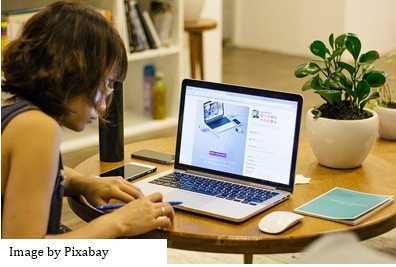
Covid-19 has already caused a huge disruption to how we all live our daily lives in the short term and it is very likely that it will change the way we all work in the long term.
Before the Covid-19 crisis, 14 percent of Irish employees worked from home in some sort of formal capacity, either sometimes or usually (Redmond and McGuinness, 2020). This meant that staff would work one or two days a week from home with a much small number being allowed to work from home five days of the week. This has shifted during the pandemic to 47%, meaning that almost overnight the number of employees working from home tripled (Burke-Kennedy, 2020).
Before Covid-19, the consensus was that offices were the key to productivity, culture and getting the best talent. Companies were always trying to compete with each other by having offices in the best locations. Organisations made the move to densification and open plan office designs to promote collaboration (Boland et al., 2020). This has all been rendered unimportant because of WFH (Work from Home).
As well as upsides there’s downsides
During the pandemic, many people have been surprised by how effectively the transition from office to home work happened. According to a McKinsey report, 80% of staff stated that they enjoyed working from home. 41% have said they are more productive than they had been whilst 28% found that they were just as productive (Boland et al., 2020). The liberation from long commutes and travel times has meant that people are now able to exert greater flexibility over their personal and professional lives along with simply having more free time. For organisations, they can access greater talent pools, adopt new processes to boost productivity and reduce the cost associated with having a full office building.
The current WFH set up does however have its drawbacks. There are more distractions and disruptions, especially for those that have children under the age of 17 (Burke-Kennedy, 2020). The lack of physical interaction with colleagues could lead to anxiety and even depression. People are also working longer hours with a recent study from IrishJobs.ie finding that 44% of people are working longer than they normally would have (RTE, 2020). There’s also a question around whether the productivity and satisfaction that people are currently experiencing is the result of the relationships they developed while they worked in the office. Are in person interactions how an organisations culture is developed? If WFH continues in the future, will this sentiment and culture erode?
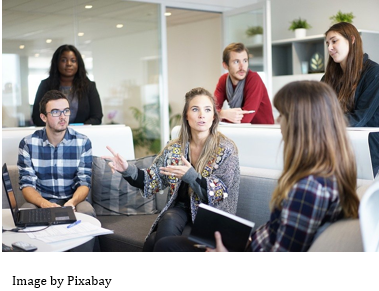
Bearing all that in mind, what does the future of work look like and how can we prepare for it?
1. Reimagined Office Spaces – If the reason that people need the office is to collaborate we may see a change in how the office is laid out. Organisations will create a space that will support the type of work that cannot happen remotely, increasing the amount of collaboration rooms. Organisations will also have to balance staff that are working from and in the office. Always-on videoconferencing, seamless in-person and remote collaboration spaces will become the norm (Boland et al., 2020).
2. Flexibility instead of WFH – Despite how much some people are enjoying work from home, it won’t be the new norm despite what some of the large tech companies are saying. Instead flexibility will be more prevalent. According to a wide body of research, people may be given greater flexibility to choose when and where they work (Ro, 2020).
3. Optimised homes – A lot of people have found WFH difficult because they didn’t have enough space or the correct equipment. In the future, when people build or remodel their homes, WFH considerations will be the new norm. Innovative technology can even help to make these spaces feel like you’re working in the office, such as a virtual desk companion that will allow you to talk to the person that would have been sitting next to you in the office (Arruda, 2020).
4. Greater Purpose – Covid-19 reminded us that intrinsic motivation is highest when people can connect the work they do to a greater purpose and mission. For example, 43 workers in a petro chemical plant lived in a factory to produce tonnes of PPE material for front line staff. People want to contribute when they understand how their role impacts larger goals. Organisations should look at creating and showcasing the tangible links between people’s roles, team objectives and the organisations strategy and purpose (Volini et al., 2020).
In truth, none of us can say with 100% certainty what the world of work will look like whenever the pandemic is over. One thing is for sure though, there’s been a seismic shift in the world of work.
Bibliography
Aruda, W., 2020. 6 Ways COVID-19 Will Change The Workplace Forever. Forbes, [online] Available at: <https://www.forbes.com/sites/williamarruda/2020/05/07/6-ways-covid-19-will-change-the-workplace-forever/?sh=4abef2b1323e> [Accessed 13 November 2020].
BBC.com. 2020. Why The Future Of Work Might Be ‘Hybrid’. [online] Available at: <https://www.bbc.com/worklife/article/20200824-why-the-future-of-work-might-be-hybrid> [Accessed 13 November 2020].
Boland, B., De Smet, A., Palter, R. and Sanghvi, A., 2020. Reimagining The Office And Work Life After COVID-19. [online] McKinsey. Available at: <https://www.mckinsey.com/business-functions/organization/our-insights/reimagining-the-office-and-work-life-after-covid-19> [Accessed 13 November 2020].
Burke-Kennedy, E., 2020. Ireland had one of highest rates of home-working during Covid-19 crisis. The Irish Times, [online] Available at: <https://www.irishtimes.com/business/work/ireland-had-one-of-highest-rates-of-home-working-during-covid-19-crisis-1.4369346> [Accessed 13 November 2020].
Redmond, P. and McGuinness, S., 2020. Who Can Work From Home In Ireland?. ESRI Survey and Statistical Report Series. [online] Economic & Social Research Institute. Available at: <https://www.esri.ie/system/files/publications/SUSTAT87.pdf> [Accessed 13 November 2020].
RTE News, 2020. 44% of people working from home putting in longer hours - survey. [online] Available at: <https://www.rte.ie/news/business/2020/0428/1135265-irish-jobsie-remote-working-survey/> [Accessed 13 November 2020].
Volini, E., Denny, B., Schwartz, J., Mallon, D., Van Durme, Y., Hauptmann, M., Yan, R. and Poynton, S., 2020. Returning To Work In The Future Of Work. [online] Deloitte Insights. Available at: <https://www2.deloitte.com/us/en/insights/focus/human-capital-trends/2020/covid-19-and-the-future-of-work.html> [Accessed 13 November 2020].