

Estelle Alley, Market Specialist, Prepared Consumer Foods & Horticulture, GB Market Bord Bia
I recently attended IGD’s [1] Annual Supply Chain Summit and one of the key themes from the day was Customer Centricity. Customers are evolving faster than ever. To gain competitive advantage in today’s UK Grocery market it was discussed that you must truly understand the customer and use this to drive action that pulls the supply chain forward.
Direct production costs are very well understood by organisations. Products also drive costs within the supply chain; often these factors are not intuitive and poorly understood by the wider business, plus different costs are associated with customers and this is often overlooked. In this instance the different supply chain costs discussed were:
- Inventory cover
- # of skus (level of customisation)
- Value per item
- Forecast ability
- Level of discounting (by customer)
- Geography (full truck, v pallet v cases)
By combining customer value and product costs an organisation can only then understand the full picture of profitability.
Supply chains of the future will be segmented and flexible according to customer and product dimension; that potentially means supplying the same product via different routes in order to manage cost and stock investment. Collaboration and information sharing on supply chains will be the challenge and the key. The aspiration is a supply chain that is reliable, affordable and sustainable for the customers of tomorrow.
A customer centric approach with customers help organisations reduce volatility in their business. In turn, this will drive consumer benefits such as better availability and reduced costs. By deepening trust between partners over time, you can pursue longer-term projects to add value. Identify ways to create products or experiences your customers value. To achieve the biggest impact, look for opportunities across the value chain with multiple business functions. You need to stand out beyond the financial value you can add by redefining your service proposition in a way that differentiates from others.
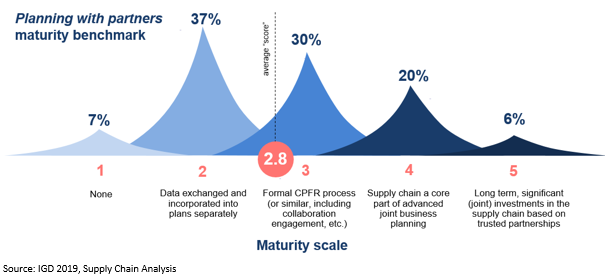
IGD say that 93% of businesses are working with customers to some extent. But a surprisingly large number (37%) said this is limited to data exchange. 26% of businesses have moved further, with supply chain projects in their joint business plans.
At an industry level, there’s a huge opportunity to do more, but you won't reach a ‘Trusted Partnership’ level with all customers, nor should you attempt to.
One last insight I took away from a customer presentation at the Supply Chain Summit was that “Scale is not an excuse for being or not being customer centric.”
Bord Bia are running a Supply Chain Optimisation workshop on Friday 24th January, 2020 which will be focused on developing UK Customer Advantage in the Supply Chain. Key objectives of this workshop are to:
- Highlight the key requirements that UK retailers require suppliers to address
- Share best practice insights into how leading suppliers can gain competitive advantage via their supply chains
- Provide insights into key tools and techniques for suppliers to self-diagnose and improve the understanding of their own customer-experience, and identify areas for improvement
Please share this link with your Commercial and Supply Chain managers
Register your interest here. Participation is Free of Charge.
Further information on the Brexit support services can be found on Bord Bia’s Brexit page: https://www.bordbia.ie/industry/trading-with-uk/
Sources:
[1] The Institute of Grocery Distribution www.igd.com