

Jack Monaghan, Intern Global Business Development Team, Bord Bia
Thomas Gavin, Global Graduate, Capability Development, Bord Bia

Maintaining good communication both internally and externally -with customers, suppliers, consumers and other stakeholders across the supply chain- is always important for a successful business. But, in our current turbulent reality, it becomes even more important to maintain such relationships. Below we focus specifically on how to deepen the relationship between company and consumer during the Covid-19 crisis.
In their recent Harvard Business Review article, Waldron and Wetherbe (2020) shared a 5-point strategy that has proven effective in both weathering a crisis and deepening the bond with consumers. The HEART framework of sustained crisis communication can help to ensure that your company is maintaining high quality communication with your consumers and can be seen below:
Humanise your company
Educate about change
Assure stability
Revolutionise offerings
Tackle the future
Humanise your company
Companies should communicate that they understand the difficult situation many of their consumers find themselves in and aim to reduce their focus on profit-generating messages or campaigns at this time (when these might be perceived as insensitive). Dialling-up any initiatives they are implementing to help the lives of their consumers, employees and stakeholders is a good idea for companies, assuming that these are genuine, authentic and aligned to the company ethos rather than being solely profit driven. One example is the Tipperary Food Producers who have collaborated to create a hamper of food and drink supplies from the region, including free delivery, an example of a community of producers working together to support each other, use existing channels of some for the greater good of all, and playing to the will of consumers to support local food at this time. There are many examples of such initiatives successfully engaging directly with consumers in recent weeks.
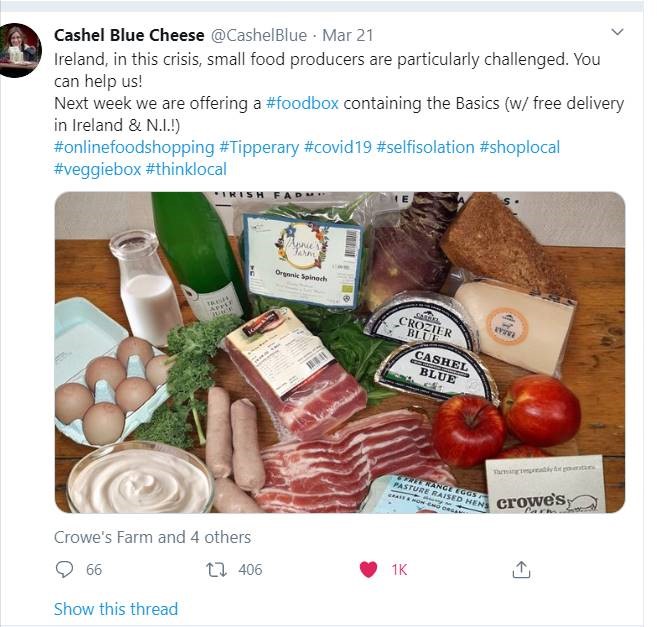
Source: Cashel Blue Cheese on Twitter
Educate consumers on how to interact with your company
Any changes to operations should be communicated to consumers. Amended working hours, ordering protocol, delivery systems or facility closures should all be mentioned. These can be conveyed through the lens of co-operating with government advice, but it may make sense for a business to also convey any changes as necessary to best serve and protect their consumer.
For example, Apple closed their stores worldwide prior to many government deadlines saying that this was to ensure the safety of all their consumers. They also reached out to inform about online shopping options available and dialled-up their convenient return policies.

Reaffirm the company’s values to consumers
A crisis can really shine a light on what a business is all about and the role it plays in people’s lives. There is an opportunity to reinforce this messaging even at a time when engagement with consumers may be very different to normal. It is important to reassure consumers that you remain true to your values but this must be backed up by your actions. Trying to emulate what others are doing, even if it’s great, may not be a good fit for your business and could backfire if it’s perceived as inauthentic. Many companies have pivoted to deliver their products directly to consumers, to recreate the ‘out of home’ experience at home. From coffee roasters, to brewers, high end restaurants to more casual dining option , you don’t have to look far to find examples of companies that, due to Covid, are going direct to home. Others are servicing their community in a different way, with restaurants and bakeries among many to make their produce available for consumers to buy, thereby maintaining their quality credentials and providing a welcome service to people who miss eating out in their foodservice outlets. Whilst in the UK, Pret will make its first step into grocery retail with the launch of a range of coffee products available for home delivery via Amazon. In April IGD reported that Pret had brought forward its retail plans due to the impact of coronavirus which had caused the closure of its stores. Three of the chain’s most popular coffee blends will now be available to buy online via Amazon from 18 May, as it tries to establish alternative revenue streams during lockdown. More products will be added to the range in the coming weeks (IGD, 2020).

Getting the tone right here is important. Rather than taking advantage of the situation, a business must be seen to be offering a welcome service to consumers, whilst at the same time sustaining their own business, staff and indeed supplier base. In doing this, companies can reassure consumers that their value proposition will prevail through the time of crisis, further deepening trust.
Revolutionise what consumers’ value about your business.
The need for innovation can easily be overlooked in a time of crisis. As most will enter a state of survival mode, it is important to remember that amidst struggle there can be opportunity (as we have just seen). After reassuring consumers that your value proposition is still intact, now is the time to explore whether innovation might help you to stay relevant in the ‘new normal’. Tell consumers how your business is now operating in new ways, offer them new products and services that will solve a new need or problem. In the short term countless Irish companies have adapted their businesses to produce essentials goods for use during the pandemic. Clothing companies moving to make scrubs and PPE and distilleries making sanitiser are well-documented examples, applauded as a great way to give back to the community. In China, Luckin Coffee, a domestic rival to Starbucks, began delivering alcohol -based sterilisers and antibiotic and soap in addition to its beverages and stocking its network of vending machines with the sanitiser products.
What consumer or societal needs might your company be able to credibly address, through an innovative approach, for the longer term?

Stellasun666 / CC BY-SA (https://creativecommons.org/licenses/by-sa/4.0)
Tackle the future
Although it will depend somewhat on emerging government guidelines, it is worth establishing a timeline for a plan to emerge from this crisis. By putting a plan in place and factoring in resources needed you can ensure that the business is in a good position to operate effectively, even if the business model has evolved. Furthermore, capture key learnings the crisis has presented and how it will improve the business post-crisis. Although it may take time, aim to emerge stronger than before, and don’t be afraid to communicate this ambition. It’s important to assert control rather than let the situation control the company.

Implications for Irish Suppliers:
Irish suppliers seeking a proven strategy to help them weather a crisis and deepen their bond with consumers should adopt the HEART framework of sustained crisis communication introduced above.
Sources
Waldron, T. and Wetherbe, J., 2020. Ensure That Your Customer Relationships Outlast Coronavirus. [online] Harvard Business Review. Available at: <https://hbr.org/2020/04/ensure-that-your-customer-relationships-outlast-coronavirus> [Accessed 1 April 2020].
IGD ShopperVista. 2020.