

Anna Ryan, Meat Division, Bord Bia – Irish Food Board
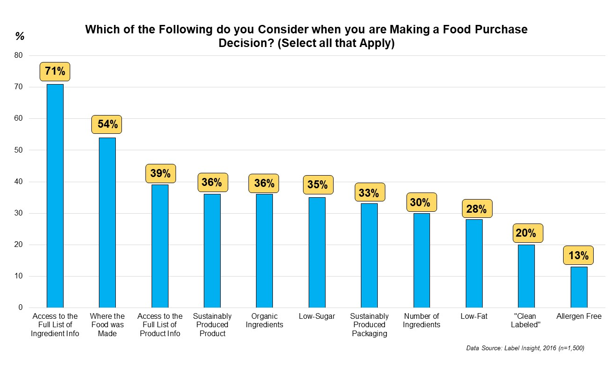
For today’s consumer, environmental and social factors are frequently considered when making a purchase, alongside the traditional drivers of taste, price and convenience. In addition, consumers today are also spending more time researching what products and companies most closely align with their specific needs and wants, and when it comes to food and drink space, these needs are often underpinned by product transparency.
How Are Consumers Making Purchasing Decisions?
According to a 2017 Trends Report, consumers are more frequently making purchasing decisions based on the tenets of “self, society and planet”. “Self” refers to considering how the food that the consumer buys enhances their quality of life, and is linked to the desire for clean, organic, less-processed and fewer-ingredient product choices. “Society” considers what the company contributes to the community in which it operates and serves, and includes cause programmes such as employee wages, manufacturing standards, employee polies and community support. Finally, “planet” deals with how the company adds to the world, and looks at eco-social issues such as animal welfare, land management and energy, water and waste management.
As a result of this shift in consumer expectations, the food industry has seen growth in clean-label and ingredient-free initiatives, such as no added sugar and no artificial flavours. These labels, as well as the demand for more natural, wholesome food has highlighted the importance of transparency.
Image Source: Alexas_Fotos on Pixabay
Implications for Company Transparency:
As previously mentioned, today’s consumer is very tuned in to the food that they eat, where the ingredients have been sourced and how the food has been produced. They are also willing to invest time researching the companies that they buy from in order to determine whether or not they align with their beliefs. In today’s modern digital age, this has become increasingly easy to do. Consumers have access to more information than ever before, and have the ability and freedom to easily seek out and purchase products that meet their specific needs and wants. If a brand doesn’t provide the information that they want on the label, the consumer will look for that information elsewhere. Label Insight’s 2017 Shopper Trends study showed that 74% of shoppers turn to the internet to seek out information that hasn’t been provided to them via the product label. This means that it is increasingly important for companies to provide clear information regarding the product, what’s in it and how it was produced, in a way that makes it easy for the consumer to access and understand.
Opportunities & Challenges:
The rise of transparency presents both opportunities and challenges for companies operating within the food and drink space. Brands now must share far more detailed information than ever before, and this must go beyond advertising and mandatory regulatory disclosures.
Today’s consumer’s expectations regarding sustainability and health measures are putting pressure on supply chains to be transparent, agile and customisable. According to KPMG, improved supply chain transparency, trust, customisation and agility enables organisations to deliver on customers’ value levers. This puts pressure on firms to keep up with these ever-evolving consumer data demands. For those companies who have this information, there is still a challenge when it comes to the best way to capture this information, share it and integrate it into the various channels. To meet this growing market demand, organisations need to provide transparency of product information throughout the supply chain. They need to have the capability to associate information with products and maintain that association through multiple tiers across the supply chain.
Transparency offers companies the opportunity to build higher levels of brand loyalty through increased levels of trust. According to a 2016 survey by Label Insight, 94% of respondents state that they are more likely to be loyal to a brand that offers complete transparency. Furthermore, 81% of respondents say that they would be willing to try a brand’s entire range of products if the company offers complete transparency, and 73% of respondents stated that they would be willing to pay more for a product that offers complete transparency. Therefore, companies who can effectively implement transparency into their strategy and communicate this effectively have the opportunity to build brand affinity among their core customer base.
References
FutureCast, Barkley. (2017). The Snack Hack: What you need to know about modern consumer snacking culture. FutureCast. Retrieved from http://www.millennialmarketing.com/wp-content/uploads/2017/02/FutureCast_The-Snack-Hack-1.pdf
KPMG. (2019). FMCG and retail value chains - The future of supply chain data. KPMG. Retrieved from https://assets.kpmg/content/dam/kpmg/au/pdf/2018/future-supply-chain-data-consumer-goods-retail.pdf
Label Insight. (2016). Driving Long-Term Trust and Loyalty Through Transparency. Label Insight. Retrieved from https://www.labelinsight.com/hubfs/2016_Transparency_ROI_Study_Label_Insight.pdf
Label Insight. (2017). 2017 Label Insight Shopper Trends Survey. Label Insight. Retrieved from https://www.labelinsight.com/hubfs/Downloadable%20Content/2017%20Label%20Insight%20Shopper%20Trends%20Survey.pdf