

Niamh Kennedy, Fellow Germany, Bord Bia - The Irish Food Board
Germany, "the most innovative nation in the world," according to the latest Bloomberg Innovation Index is not only innovating in the mechanical engineering sector, but also in the food industry, with a focus on sustainability and reducing plastic use in the food sector. By rapidly adapting to shifts in consumer environmental consciousness and engagement, retailers and suppliers are aligning with the German consumer lifestyle trend of wanting to live responsibly. (Business insider, 2020) (Fitch Solutions,2019)
Recent figures from the Deutsche Verpackungsinstitut (German Packaging Institute) show that approximately 70% of German consumers have not purchased a product due to the (un)sustainability of the product’s packaging. 1 in 5 consumers regularly refuse to purchase products that are not packaged sustainably and 50% have done so at some stage in the past. Only 30% of consumers do not consider the sustainability of the packaging to be a deciding factor when purchasing. (The German packaging institute,2019)
Consumers are therefore pushing this trend and since packaging is a "clear and immediate representation of a brand’s commitment to sustainability" (Bord Bia, 2018), the retailers themselves are taking this responsibility into their own hands. Retailers have begun to lead by example and are focusing on making their private label offerings more sustainable. This is how they aim to reduce their consumption of plastic, with 2050 being the year in which both Kaufland and Lidl (subsidiaries of the Schwarz Group) will reach their strategic goal, which is to reduce plastic consumption by at least 20% and ensure 100% recyclability of its plastic packaging.
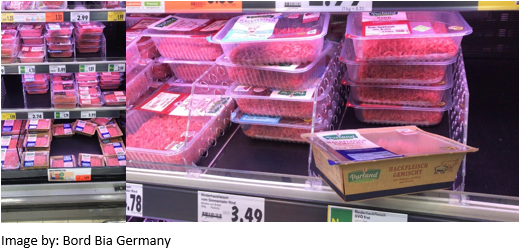
One example of how Kaufland has introduced this "Reset Plastic strategy" from Schwarz Group is in their practical implementation of the new packaging format for mixed (pork & beef) minced meat, in their own brand quality meat range, K-Purland. This new packaging format (a carton lined with plastic), which has a proven quality can be seen in many stores in Germany since September 2019. The price has remained the same, however this new packaging contains 70% less plastic and is easy to recycle.
Kaufland's reduced plastic packaging will decrease Kaufland's plastic consumption by 125 tonnes per year. (Kaufland, 2020) According to Robert Pudelko, Head of CSR Purchasing Germany, minced meat is one of the best-selling foods in Kaufland's self-service meat department. For this reason, it was so important for Kaufland to find a sustainable solution that could be used to achieve a lot. (IGD, 2019)
These innovations can be clearly recognised in store with their 'consciously packed' (Kaufland) and 'responsibly packed' (Lidl) logos on all products which qualify. The labels are not only seen in the meat aisles, but in fact throughout the FMCG sector. These innovations align to the trend of living responsibly and should inspire Irish suppliers and retailers. Irish suppliers in the FMCG sector who wish to succeed should continue to keep this trend at the core of their business, especially when focussing on the German market.
References:
Bord Bia (2020) Consumer Lifestyle Trends. Retrieved 26 January 2020, from https://www.bordbiaconsumerlifestyletrends.ie/
Damm, C. (2020). These are the world's most innovative countries. The US isn't even in the top 5. [online] Business Insider. Available at: https://www.businessinsider.com/these-are-the-10-most-innovative-countries-bloomberg-says-2020-1?r=DE&IR=T#2-south-korea-9 [Accessed 26 Jan. 2020].
Deutschen Verpackungsinstituts e. V. (dvi). (2019). Für 70 % der Konsumenten entscheidet beim Einkauf auch die Nachhaltigkeit der Verpackung. [online] Available at: https://www.verpackung.org/news+M5f1eee2af55.html [Accessed 26 Jan. 2020].
Fitch (2019). Sustainability Trends: Influencers, Drivers and Implications by Industry. [Accessed 26 Jan 2020].
IGD Retail Analysis. (2018). Kaufland pledges to reduce single-use plastics. [online] [Accessed 26 Jan. 2020].
IGD Retail Analysis. (2018). Kaufland pledges to reduce single-use plastics.[Accessed 26 Jan. 2020].
Kaufland. (2020). Wir sagen Plastikmüll den Kampf an. [online] Available at: https://unternehmen.kaufland.de/unsere-verantwortung/machen-macht-den-unterschied/plastik-reduktion.html [Accessed 26 Jan. 2020].
Lebensmittel Zeitung. (2019). SB-Fleisch: Kaufland will noch mehr Plastik einsparen. [online] Available at: https://www.lebensmittelzeitung.net/handel/SB-Fleisch-Kaufland-will-noch-mehr-Plastik-einsparen-140706 [Accessed 26 Jan. 2020].
Lidl-nachhaltigkeit.de. (2020). Plastikreduktion. [online] Available at: https://www.lidl-nachhaltigkeit.de/nachhaltigkeit-bei-lidl/plastikreduktion/ [Accessed 26 Jan. 2020].
REset Plastic. (2020). REset Plastic. [online] Available at: https://reset-plastic.com/en/ [Accessed 26 Jan. 2020].