

Ellen Codd, Amsterdam office, Bord Bia - The Irish Food Board
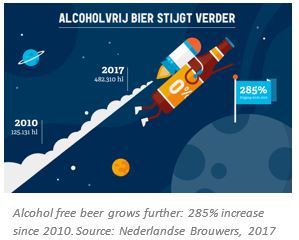
Beer culture in the Netherlands is changing. As the most popular alcoholic drink, the beer industry as a whole has experienced positive growth, with volume sales increasing by 2% in 2016 and an expected CAGR of 2% (Euromonitor, 2017). Traditionally known for its brewing giants Heineken, Grolsch, and Bavaria, the Netherlands is experiencing a craft and low/non-alcoholic beer boom. Speciality beers are outperforming the market, with consumption growth of 7.9% from 2016 to 2017, in comparison to 1.5% growth in the total market. Alcohol-free beers show the strongest overall growth for the eight year in a row, with consumption rising by 24.7%.
This shift in consumption is changing beer culture more towards that of wine culture, with restaurants and bars increasingly offering extensive specialized beer menus and offering beer pairing suggestions with their food menus and some restaurants even employing beer sommeliers. This trend is also appearing in retail, with market leading retailer Albert Heijn offering meal suggestions with their beer range. As the Dutch consumer becomes more health conscious, consumers are favouring higher quality ingredients and personalisation, and are willing to pay more for a premium product (BMI, 2017).
The number of microbreweries has quadrupled in the last decade, increasing from 90 in 2007 to 370 at the end of 2017, growing by 75 in 2016 alone. However, there are no craft breweries competing directly with the major breweries just yet, as both retailers and traditional brewers are also targeting niche consumption. Breweries such as Heineken and Brand are capitalising on this trend with 0% and craft beers. In retail, supermarkets are also increasing their speciality and alcohol-free ranges, with speciality beer accounting for 15% of revenue in beer sales in 2017. Albert Heijn, for example, launched its Brouwers Bier range in 2016 to compete with the increasing number of craft beers on mainstream shelves. 30 new low/non-alcoholic and a further 30 speciality beers were launched in Albert Heijn this year. Beers are also increasingly sold individually in mainstream retail, allowing consumers to easily try new varieties. Beer is expected to remain the most popular alcoholic beverage while demand for craft varieties is set to grow at a robust pace (BMI, 2017), offering opportunities to tap into across Dutch retail and foodservice.
For more information contact ellen.codd@bordbia.ie.