

Michael Hussey, Manager Alcoholic Drinks & Seafood, Bord Bia – The Irish Food Board
The population of Japan is expected to shrink from 126.5 million in 2017 to 124.3 million by 2022. The dependency ratio (over-65 population as a share of the working-age 15 to 64 population) is one of the highest amongst the OECD nations. The contracting population is attributed to the low fertility rate in the country and stringent immigration laws rule out the possibility of immigrants contributing to the country’s population growth.
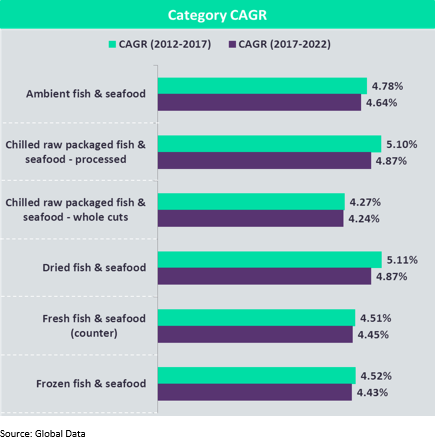
Per capita consumption of fish & seafood in Japan is 48Kg per person per annum, which is one of the highest in the world. Processed ‘Chilled raw packaged fish & seafood’ is the largest category with value sales of J¥284.3 billion (€2.42 billion) in 2017. The ‘dried fish & seafood’ category is forecast to grow the fastest at a CAGR of 4.87% during 2017–2022. It is followed by ‘chilled raw packaged fish & seafood - processed’ (4.87%) and ‘ambient fish & seafood’ (4.64%). See Table 1 below
Table 1: Value growth of the different seafood sectors.
The country is a huge net importer of seafood at 2.1 million tonnes. The market is looking for prime species (whole fish, fillet) bulk frozen and molluscs. It is a key importer of frozen mackerel (70,000 tonnes)& 30,000 tonnes of frozen horse mackerel and 25,000 tonnes of cannel mackerel.
Retail accounts for 43.5% of seafood sales while foodservice is growing in importance for seafood and accounts for 56.5% . This is being driven by a number of factors-
- Increasing female participation in the workforce means less time to cook at home.
- The growth in “Nakashoku” or home meal replacements. These are sold by retailers, notably the big convenience stores such as 7 Eleven & Family mart, but are considered foodservice in the local market. They are ready to eat, mainly bento boxes and are sold chilled or frozen and often purchased frozen in the morning and left to thaw for lunch.
- Many younger Japanese consumers are not cooking and are looking for convenience or eat out.
Irish seafood exports to Japan were valued at €16 million in 2018, representing an increase in value of 54% compared to 2016. Key species exported from Ireland were pelagic fish: mackerel (3,000 tones) and horse mackerel (1,000 tonnes). Mackerel accounted for €7.8 million of sales in 2018, and horse mackerel €5.6 million. Japan is now the second largest market for Irish mackerel and horse mackerel. In addition we also see excellent growth in a variety of seaweed, molluscs, clams, crabs, oysters, mussels, shrimps and prawns.
5 Irish seafood exporters exhibited at the recent Japan Seafood Expo in Tokyo. The show is a small but very focused with buyer attending from all the major multiple retail chains in Japan as well as key seafood distributors into retail, foodservice and specialist stores. The key objectives of participation at the show were to grow our existing relationships with key seafood importers and buyers and seek out new opportunities in both retail & foodservice. In Japanese culture, building and maintaining relationships with your potential and existing customers is a key requirement to developing long term business. Making a breakthrough can take time but once the relationship is established and maintained, Japanese buyers tend to be more loyal than in other markets.
The Japanese consumer is more willing to pay a little extra for quality product which is backed up with a provenance message. Bord Bia has been promoting Irish seafood in key trade magazines to raise awareness of Irish seafood among trade buyers. In addition, a number seafood promotions are in train with Aeon, one of the key retailers in Japan to raise awareness among the Japanese consumer of seafood from Ireland. The market is an attractive one for seafood exporters, especially pelagic exporters, but there remains opportunities for other species in this market of growing importance for Irish seafood exports.
For more information contact Michael.hussey@bordbia.ie
Sources: Bord Bia; Global Data: Euromonitor International: Orani:Bord Bia