

Cormac Coughlan, Seafood Global Graduate, Bord Bia – Irish Food Board
Oysters are considered a luxury seafood in Italy and the Italian market consumes approximately 4,400 tonnes of oysters per year (Agron International Marketing Research, 2018). Demand for oysters in the Italian market has been quite stable for the past 2-3 years. 2007/2008 saw a big downturn in the oyster market, as the financial crisis decreased the spending power of the Italian consumer, but since then the market has grown again. In 2017, the total market value at production level was around €18.5 million.
About Oysters
About 98% of the Italian market is dominated by concave oysters (Crassostrea gigas), also known as pacific, rock or gigas oysters. These oysters are elongated in shape and have a concave surface. They are generally available throughout the year and are known for their salty flavour.
The other 2% of the market is made up by the European Flat Oyster (Ostrea edulis). They are round in shape and have a flat surface. The flat oyster takes longer to grow and production is limited during certain times of the year. They are a niche product, generally more expensive than concave oysters and their taste is said to be milder in comparison.
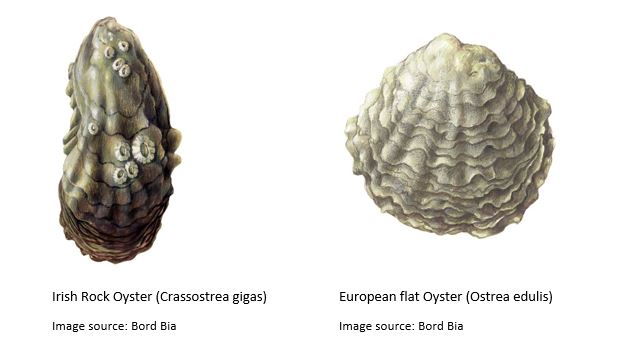
Where they come from
In 2017, about 70% of the oysters in Italy were imported from France. Almost 30% of the market was filled by Dutch oysters, known for their competitive price and a medium level of quality. The Irish oyster can be found in the Italian market but in limited volumes.
Italian oyster production is very small compared to other molluscs such as mussels and clams. In 2017, Italy exported approximately 200 tonnes of oysters, 50% of which is said to be grown originally in Italy. In general, Italian consumers do not have a taste for Italian oysters. Interestingly, about 30% of French oysters imported in Italy are originally from Ireland. They are transported from Ireland and farmed in French waters for at least 6 months, which technically makes France their country of origin.
Italian Consumer
Christmas is the busiest time of year for oyster consumption in Italy. About 20% of oyster consumption takes place around Christmas time. Apart from this time period, consumption is generally stable, with a further peak around Valentine’s Day in February. Summer consumption is mainly through foodservice and is located in fashionable tourist locations, especially Sardinia.
The opportunities for Irish oysters lie in the medium to high range quality of products, especially in foodservice. For this to be successful, their price must be able to compete with French oysters.
Distribution
For mass market retail in Italy, oysters are generally purchased from purification centres. The purification centres are very central to the mussel and clam market in Italy, but the oyster market is less reliant on them.
In the foodservice sector, high-end restaurants are known to skip purification centres and purchase exclusively from distributors who have contacts with the countries of origin. In this area, the quality of the oyster is very important and the price is generally less important.
Italian distributors and wholesalers generally purchase oysters from Italian purification centres, directly from foreign distributors and also from foreign purification centres.
Opportunities for Irish Producers
Italy is the seventh largest market for imported seafood in the world and is the third largest in Europe, behind Spain and France (Eurofish, 2018). Italian imports of fisheries and aquaculture products reached a value of €6 billion in 2017, while seafood sales in Italy increased by 4% in total volume terms to 513,000 tonnes (Passport, 2018).
All-in-all, Italy has the potential to be a strong market for the export of Irish oysters. Currently, most opportunities for Irish producers lie in the foodservice sector, where the focus is on quality produce. With a close proximity between the two countries, sharing the same currency, and legislation in place to trade freely through the EU, Italy is certainly a market that Irish producers could look to in the future.
References
Agron International Market Research (2018), The Italian market for shellfish: Oysters, Mussels, Brown Crab and Lobster. Milan, Agron International Market Research.
Eurofish (2018), Overview of the Italian fisheries and aquaculture sector. https://www.eurofish.dk/italy
Passport (2018), Fish and seafood in Italy. Euromonitor International.