

Nicolas Ranninger, Director, Bord Bia Africa
The African market and its 54 nations results in diverse range of cultural, political and economic environments that can be at first difficult to apprehend. Three key dimensions should be considered in order to apprehend this market.
- Demography. With a population of 1.2 bn people that will reach 2.5 bn by 2050. Africa will account for half of the world population growth by 2050 and by 2100 predictions suggest that Africa will account for a third of the world population, by 2030 ¼ youth population will be African( Source UN)
- Wealth. Since the beginning of the century, the African economy has been catching up with those of mature markets fueled by increased natural resources prices, foreign investment, technological jumps, urbanization and growing middle class. Between 2010 and 2023 the overall African GDP is expected to grow by an annual average of 4% , double of the EU expected growth. In 2019, 4 of the top 5 fastest economies in the world are in Africa. ( source IMF and CNBCAfrica) According to the world bank the African food market value could reach $1 trillion by 2030 if the required capital, electrical and technological support is provided.
- Logistics. Poor infrastructure and distribution remain one of the key constraint for business development in Africa, in particular for internal trade between countries, despite progress made through African Continental Agreement on Free Trade Area (AfCFTA)
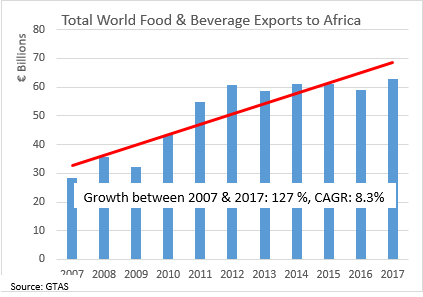
A growing population and growing wealth combined with underperforming agricultural sector, storage and distribution, has led to a significant growth in African demand for imported food ( average +8 % per year) , notably for cereals (HS10), fats (HS15), sugars (HS17), but also dairy, meat prepared foods and seafood. Some of the main suppliers to Africa are Brazil (Sugar and Meat), France (cereals, dairy, meat) South Africa (beverage), Netherlands (dairy, seafood), China ( Tea and Seafood).
Irish exports to Africa reached €557m in 2018 representing growth of 59% since 2010.
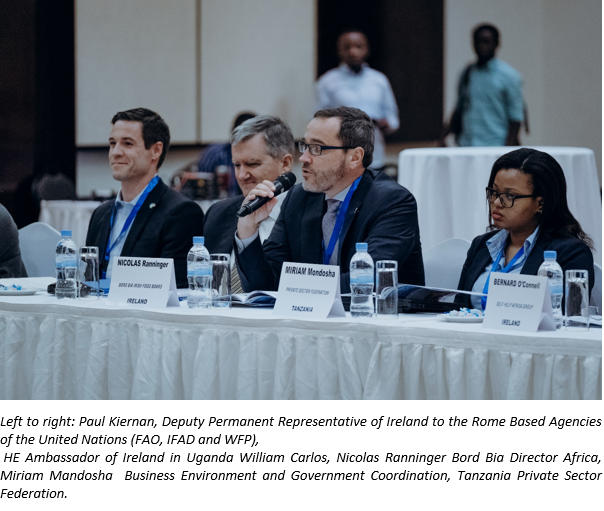
As in Ireland, the development of national food production and import controls is a political priority for many African countries. Bord Bia in partnership with the Irish Department of Agriculture and University College Dublin participated in an United Nations FAO initiative in Rwanda this week where public and private sector representatives from 10 African countries gathered to participate in workshops focussed on sustainable agri-food sector development. Irish learnings and case studies were a key part of these discussions with the objective of embedding strategic planning and education into developing the industry.
Understanding the African continental, regional and national political, economic and cultural environment are some of the key criteria that exporters need to consider. Bord Bia has a strong team in place to assist exporters to identify, understand and unleash opportunities in Africa with Ese Okpomo, Market Specialist West Africa, joining the team based out of Lagos, Nigeria, to work alongside the existing network of in-market experts covering North Africa and Southern Africa.