

Italy’s Beef Sector: 4 P’s to Purchase
Flora Igoe, Global Business Development
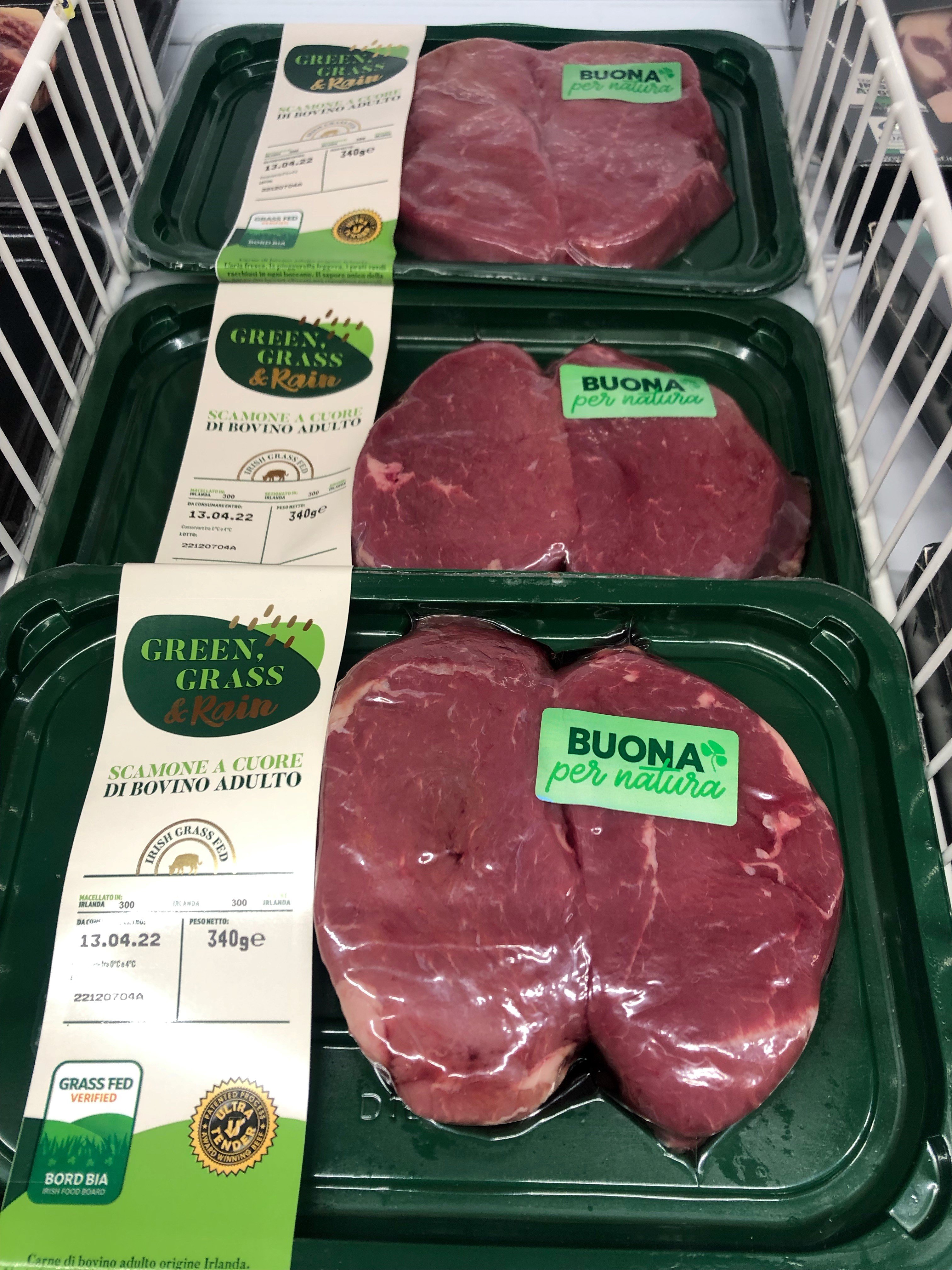
Image by: Flora Igoe
Price, Provenance, Packaging and Premium are four key drivers that matter to Italian beef consumers. This insightful article looks at the presence of each P in the Italian market and its relevance to the Irish beef sector.
- Price
Rising inflation (+4.7% year-on-year) is fuelling consumers concern for expenditure (Horeca News, 2022). Beef prices are estimated to have increased by 19% between 2020 – 21 (Ismea, 2021). As a result, we see less frequent purchase of beef at retail level. In foodservice there are less steak options (fillets & striploins) as demand for such cuts is outstripping supply. Restaurants are either reducing the number of beef items on the menu or replacing fillets and striploins with round cut steaks. Mid-range foodservice operators are replacing steak type cuts with “premium burgers” to achieve margins (Various trade market sources).
By 2022 prices have continued to rise with petrol and energy prices growing by 46% to affect the whole supply chain (Horeca News, 2022). In March, Italy reached a record price of corn at 400 euros per ton. To put this into context, Italy imports 47% of its corn for animal feed. The increased production costs affect 10% of consumer prices making Italy’s consumers increasingly sensitive to price (ANSA, 2022). While price surges slow down the purchase of beef in Italy, consumers are claiming to buy less but higher quality beef (Shopper Insights, 2021). Irish beef is uniquely positioned to fulfil the Italian consumer needs in this space.
- Provenance
Buying local is the biggest driver for Italian consumers. Regionalism and tradition play into this driver (Shopper Insights, 2021).
As the world leader in its number of certified PDO-PGI products, Italy boasts 841 out of 3,249 globally. These are region specific products, protected by EU quality schemes to promote their unique characteristics. Certified products are marked as either PDOs (protected designation of Origin), PGIs (Protected Geographical Indication) or TSGs (Traditional Speciality Guaranteed) (European Comission, 2022). One fifth of Italy’s food industry profit comes from this sector. In 2021 Italy’s PDO and PGI fresh meat production value reached 92 million euros, 1% of the PDO-PGI sector (Eurocarni, 2022).
Italy’s split of modern to traditional trade is 67 – 33% respectively. Traditional trade is expected to generate sales of €59 billion in 2026, which underlines its continuous importance in Italy (IGD, 2021). Traditional open-air markets and butcher trade are particularly important for Italy’s consumers, especially since the Covid-19 Pandemic. The importance is highlighted by a 2022 Dolce & Gabbana campaign, “Autentica,” which involves Butcher Giorgio Pellegrini, President of Milan’s Butchers’ Association. Giorgio Pellegrini collaborates with Bord Bia in its Meat Academies, which serve to educate Italian consumers and foodservice professionals on the qualities of beef and lamb, using Bord Bia Quality Assured Irish meat. Italian consumers who value provenance are more likely to trust and favour Irish beef as a result.
- Packaging
The economic fluctuations, local and global events of 2020-21 have shaped consumers’ behaviours, attitudes, and values worldwide (Mintel, 2022). Italy’s consumers are the more likely than others to be Eco-Conscious (Shopper Insights, 2021). Various indicators of this trend are present in the market:
Carrefour has relaunched its organic chicken product in Italy with plastic free packaging while Esselunga’s Bio brand’s minced beef and burgers use packaging made of 85% paper.
Esselunga’s Certified Irish Angus Beef Striploin product will relaunch in the Italian market this year with a new eco-friendly pack made of 75% less plastic.
Esselunga’s Grass Fed beef rump product changed packaging from transparent plastic to green. This matches the grass Fed Logo, further associates the product with Ireland and makes it more visually appealing, as the appearance of the beef is a key reason Italy’s consumers purchase beef on impulse when in-store (Shopper Insights, 2021).
These indicators support claims that strong motivators for future purchase decisions of Italy’s beef consumers include presentation, packaging and strong quality and trust messaging (Shopper Insights, 2021). Brands should continue to provide clear on-pack information to highlight the environmental impact of product and packaging so that consumers feel rewarded for their purchase decisions (Mintel, 2022).
- Premium
Italy’s beef consumers claim to be buying less, but higher quality beef. They are strongly motivated by Grass Fed as a means for them to trade-up to a more premium type of beef (Shopper Insights, 2021).
For Italy’s beef consumers, breed is especially important in the context of premium. Preference for Irish beef amongst Italian breeds is strong. The most preferred breed is first, Chianina, followed by Piedmontese and thirdly Black Angus, which, for Italy’s consumers, is most strongly associated with Ireland (Beef Brand Health Research, 2022).
Other premium beef available in Italian retail includes Australian, Argentinian, American and Japanese (Kobe) beef. Irish Premium offerings in the retail channel include Black Angus, Hereford, Tipperary Dry Aged Club Steak, Roast beef and Tomahawk products. The Tomahawk cut is a particularly good example of the Italian consumers willingness to buy premium, since it is priced at €4 more per kilogram than an entrecote cut (the same cut with bone removed).
By leveraging the 4 P’s to purchase: 1. Price, 2. Provenance, 3. Packaging and 4. Premium trends, the Irish beef sector will be better positioned to meet the needs of Italian beef consumers.
References:
ANSA, Editorial Staff. “Ucraina: Cai, Grano e Mais Sfondano Quota-Record 400 Euro/Ton - Terra & Gusto.” ANSA.it, 11 Mar. 2022. Available at: https://www.ansa.it/canale_terraegusto/notizie/mondo_agricolo/2022/03/11/ucraina-caigrano-e-mais-sfondano-quota-record-400-euro/ton_d4a85377-c6c4-4065-a521-c1fe40f05baf.html (Accessed 1 April 2022)
Bord Bia, 2021. Meat Shopper Insight 2021 – ITALY.
Bord Bia, 2022. Beef Health Research 2021 – ITALY.
Corona, Sebastiano. “XIX Rapporto Ismea-Qualivita, DOP e IGP Nell'anno Della Pandemia.” EuroCarni, Apr. 2022, pp. 84–86.
European Commission, “Quality Schemes Explained.” European Commission, 31 Mar. 2022. Available at: https://ec.europa.eu/info/food-farming-fisheries/food-safety-and-quality/certification/quality-labels/quality-schemes-explained_en#:~:text=PDO%20%E2%80%93%20protected%20designation%20of%20origin,spirit%20drinks%20and%20aromatised%20wines) (Accessed 1 April 2022)
Horecanews, Editorial Staff. “L'inflazione Spinge I Prezzi Alimentari Del +5%. Ecco La Top 10 Degli Aumenti.” Horecanews.it, 18 Mar. 2022. Available at: https://horecanews.it/linflazione-spinge-i-prezzi-alimentari-del-5-ecco-la-top-10-degli-aumenti/ (Accessed 1 April 2022)
IGD, 2021. Insight on Italy. The Market and its growth prospects to 2026. IGD Retail Analysis
Ismea, 2021. Tendenze - Bovino da carne n.2/2021 – December 2021. Available at: file:///C:/Users/figoe/Downloads/Le_dinamiche_mercato_carni_bovine_novembre_2021def%20(1).pdf (Accessed 1 April 2022)
Mintel, 2022. What the 2022 Consumer Trends Mean for Packaging. Mintel Group Ltd