

Alternative labels impacting the organic market in France
Orla Murphy, International Graduate, Paris Office
Organics in France
France is Europe’s biggest organic producer in terms of farmland dedicated to organic production (Ministère de l’Agriculture et de la Souveraineté alimentaire, 2023), and the organic market is worth €12 billion according to figures from l’Agence Bio, the governmental agency responsible for the promotion of organic farming (Agence Bio, 2023a). While organic and local often go hand in hand, in 2022 30% of organic products consumed in France were imported (Agence Bio, 2023b).
Current Context
Despite these figures, the inflationary economical context and cost of living crisis has seen the value of the organic market fall by 4.6% to €12bn in 2022 (Agence Bio, 2023a). In fact, the number of consumers who reported checking for the Agriculture Biologique (AB - Organic Farming) label on a product while shopping fell by 11% in 2022 (Agence Bio, 2023a). Almost two-thirds of French consumers choose organic for health reasons (Marchand, 2022), and are now turning their heads towards non-organic alternatives which they perceive as having similar benefits.
Pesticide-Free
In the last five years, two pesticide focused labels have been launched, mostly in the fresh fruit and vegetable category, and have seen their sales volume increase by 33% in 2022 (Lesurf, 2023). The ‘Cultivated Without Pesticides’ label seen on tomatoes follows AB pesticide regulations but doesn’t meet other requirements necessary to organic certification (Alliance Nature et Saveurs, 2019). The second label ‘Zero Residue of Pesticides’ (ZRP), doesn’t prevent the use of pesticides in production, but rather guarantees only trace levels of pesticides in its products (Reinert, 2023). However, these are up to 30% more expensive than their counterparts and are therefore not immune to recent inflation (Jourdain, 2023).
Nutriscore
The Nutriscore is a French public health initiative, launched in 2017, which labels processed foods and drinks on a five-point alphabetical scale based on nutritional content, with “A” being the healthiest. 52% of consumers choose products that are rated better when the choice is available. Consumers seem to be putting their money where their mouths are, with sales of A-rated products increasing by more than three percent while E-rated products recorded a decrease of over one percent in 2022 (Lesurf, 2023). The labelling is currently conducted on a voluntary basis, although consumer associations have recently called for it to be made obligatory (Llorca, 2023).
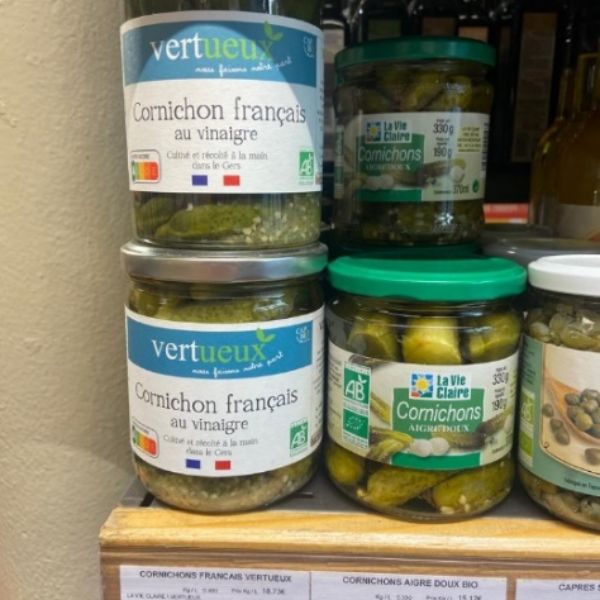
Figure 1: Pickles with organic certification, along with the Nutriscore and Made in France labels. Source: Órla Murphy Bord Bia
Nitrate-Free
In the processed meats category, sales of products with a nitrate-free label grew by 38% in 2022 (NielsenIQ, 2022). Added to meats as a preservative or to enhance colour/flavour, a certain level of this additive is permitted in organic products. At present, there is no industry-wide label but rather several labels developed by manufacturers. The negative health effects of nitrates were widely publicised in French media in 2016, and manufacturers have spent the intervening years developing new formulas to exclude this ingredient (Lacroux, 2018).
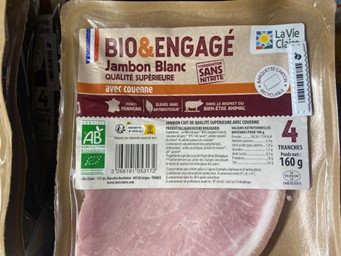
Figure 2: This organic sliced ham has multiple claims including nitrite free, Made in France, antibiotic-free, recyclable packaging, and animal welfare. This highlights how organic alone is often not enough in persuading consumers to purchase. Source: Órla Murphy Bord Bia
Animal Welfare Labels
According to l’Agence Bio, 31% of organic consumers choose organic for animal welfare reasons (Gault, 2023). Other labels exist to fulfil this motivation, such as free range in the egg category. The only distinction between organic and free-range being that the latter hens are not required to eat organic feed. In 2023, free range eggs became the most consumed type of egg representing 33% of sales volumes, versus 19% for organic (Pinson, 2023). Other animal welfare labels can be seen on meat products such as in Figure 2 and Figure 3.
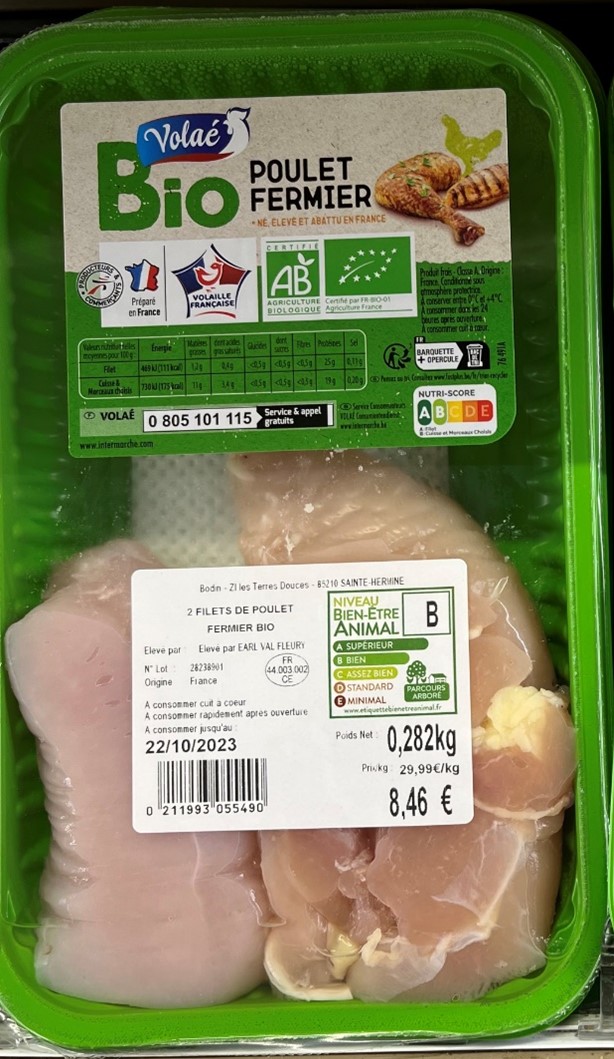
Figure 3: Organic chicken sold in Monoprix with an animal welfare score of B. Source: Germain Milet Bord Bia
Environmental Label
Health isn’t the only motivating factor for consumers choosing organic - 46% also do so to preserve the environment (Huet, 2022). This cohort of environmentally conscious consumers are presented with an increasing choice of sustainable labels, competing with the sustainability claims of organic certification. Sales of products sporting ‘responsible labels’ increased by almost 13% in 2023, and the presence of an environmental label has become essential for 86% of French consumers (NielsenIQ, 2023).
The ‘High Environmental Value’ (Haute Valeur Environnementale – HVE) standard, implemented by the French Department of Agriculture and Food Sovereignty, measures the environmental performance of food producers in areas such as preservation of biodiversity.
The Planet-score label was introduced in June of this year after the French Ministry for Environmental Transition called for proposals of environmental labels for food products, which they plan to make obligatory by 2025. It rates products based on their use of pesticides, impact on biodiversity and the climate, and their method of production. It is in competition with the Eco-score label, which has appeared on products since 2021 and rates food products in a similar manner. More information on the Eco-score is available here.
In general, made in France and other labels focusing on locally sourced products are popular amongst both consumers and retailers.
Conclusion
The organic retail market in France had a difficult 2023 as a cohort of consumers moved away from organic products in favour of cheaper alternatives. These alternatives outlined above have adequate credentials to satisfy their purchasing motivations (health, the environment, animal welfare).
It’s fair to say that these consumers are still interested in the principles of organic, which needs to be better explained to them to convince them of its benefits, a challenge which Agence Bio is undertaking through a new multi million-euro campaign across France.
In parallel, an Irish organic product with a targeted commercial proposition, strong health and environmental credentials, could feature well in this market context considering the size of the market and openness to imports across several categories
Bibliography
Agence Bio (2023a). Les chiffres du BIO Panorama 2O22. [online] Agence Bio. Agence Bio. Available at: https://www.agencebio.org/wp-content/uploads/2023/06/AB-PRESSE-2023-210x297-WEB.pdf [Accessed 1 Nov. 2023]
Agence Bio (2023b). Observatoire de la consommation bio. [online] Agence Bio. Available at: https://www.agencebio.org/vos-outils/les-chiffres-cles/observatoire-de-la-consommation-bio/
Alliance Nature et Saveurs (2019). Label Alliance Nature et Saveurs : produits cultivés sans pesticides. [online] Alliance Nature et Saveurs. Available at: https://www.alliancenatureetsaveurs.com/#faq-06 [Accessed 3 Nov. 2023]
Gault, G. (2023). Baromètre des Produits Biologiques en France - 2023 . [online] Agence Bio, p.101. Available at: https://www.agencebio.org/wp-content/uploads/2023/03/Rapport-complet_Barometre-Bio-Edition-2023.pdf [Accessed 3 Nov. 2023]
Huet, V. (2022). Baromètre de consommation et perception des produits biologiques en France. [online] Agence Bio, p.106. Available at: https://www.agencebio.org/wp-content/uploads/2022/03/Barometre-de-consommation-et-de-perception-des-produits-bio-Edition-2022_VF.pdf [Accessed 3 Nov. 2023]
Jourdain, F. (2023). Le label ‘Zéro résidu de pesticides’ poursuit sa croissance, mais l’inflation ne l’épargne pas. [online] Ouest-France.fr. Available at: https://www.ouest-france.fr/economie/agriculture/le-label-zero-residu-de-pesticides-poursuit-sa-croissance-mais-l-inflation-ne-l-epargne-pas-df04e4b2-b2fb-11ed-8161-b9ea7c7dc601 [Accessed 3 Nov. 2023]
Lacroux, M. (2018). Comment choisir une charcuterie (vraiment) sans nitrites ? [online] Libération. Available at: https://www.liberation.fr/food/2018/07/21/comment-choisir-une-charcuterie-vraiment-sans-nitrites_1667043/ [Accessed 3 Nov. 2023]
Lesurf, L. (2023). Qualité nutritionnelle : un engagement à mieux communiquer. [online] www.circuits-bio.com. Available at: https://www.circuits-bio.com/chiffres-et-marches/qualite-nutritionnelle-un-engagement-a-mieux-communiquer [Accessed 3 Nov. 2023]
Llorca, A. (2023). Faut-il rendre le Nutri-Score obligatoire ? L’UFC-Que Choisir le réclame. [online] TF1 Info. Available at: https://www.tf1info.fr/sante/video-alimentation-nutrition-courses-supermarches-faut-il-rendre-le-nutri-score-obligatoire-l-ufc-que-choisir-le-reclame-2253845.html [Accessed 3 Nov. 2023]
Marchand, A.-L. (2022). Consommateurs du bio : pourquoi et comment distinguer leurs attentes. [online] Vitagora. Available at: https://www.vitagora.com/blog/2021/mieux-comprendre-consommateurs-bio/#:~:text=Dans%20le%20d%C3%A9tail%2C%20les%20motivations [Accessed 3 Jan. 2024]
Ministère de l’Agriculture et de la Souveraineté alimentaire. (2023). Les chiffres de l’agriculture biologique en 2022. [online] Available at: https://agriculture.gouv.fr/les-chiffres-de-lagriculture-biologique-en-2022#:~:text=Le%20march%C3%A9%20du%20bio%20d%C3%A9pend