

Three Trends from the Free From Expo 2021 in Amsterdam: A Dutch market perspective
Eva Hannigan, Global Business Development Netherlands
An array of international companies exhibited their products at the Free From Functional and Health Ingredients Expo 2021 in Amsterdam in November.
The Dutch are interested in this category, with 64% of all consumers having purchased ‘free from/alternative’ products and 68% of this cohort repurchasing products from this category frequently (Bord Bia, 2021). The Netherlands also has high rates of flexitarianism in Europe and while definitions of this dietary lifestyle vary, sources show that between 24% (Bord Bia, 2021) to 42% (ProVeg, 2021) identify as flexitarian, indicative of the Dutch market’s openness to meat and dairy substitutes.
Furthermore, the trend of wellness and health among consumers has been spurred along by the pandemic with an increased demand for foods with fewer and simpler ingredients (Bord Bia, 2021), leading to increased premiumisation and innovation in the free from/alternative category. In this article, three prominent product categories at the Free From Expo 2021 will be discussed and what the implications of these trends mean for Irish suppliers exploring the Dutch market.
Chocolate
Free from chocolate was prevalent at the Expo, with Irish brand Nobó exhibiting their full range of vegan bars and chocolate buttons among other companies from Belgium, Germany and Denmark.
Chocolate in this category has evolved significantly from ‘traditional’ qualifications such as ethical sourcing, with many brands promoting traits such as keto and paleo-friendly, sugar-free and soy-free. This highlights a shift from not only focusing on sustainable production but also to what can directly benefit the consumer. Innovations in this area included the use of medium-chain triglycerides (MCT) by Belgian company Okono; fatty acids extracted from coconut oil used as a base for the chocolate to avoid oiliness and allow consumer to maintain ketosis after consumption.
Form and packaging in the chocolate category was also highly sophisticated, with companies differentiating from standard chocolate bars and emphasising their premium positioning. King Monty, a Belgian brand, offered chocolate sticks in vibrant cylindrical tins. Others opted for sleek, matte boxes such as Nobó, Okono and Magic Chocolate by the Belgian Chocolate Factory.
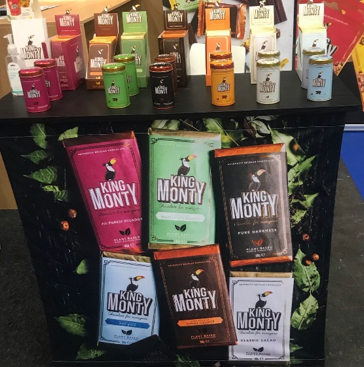
Image by: Eva Hannigan
Seaweed
While the seaweed market is less developed in Europe compared to North America and Asia (Interreg 2 Seas and Noordzee Boerderij, 2019), European seaweed products had a significant presence at Free From 2021. Underlying messages of health and sustainability featured heavily in this category, promoting the nutritional and environmental benefits of seaweed. German company OCEANFRUIT exhibited a ‘sea salad’, to be used as toppings or sides for dishes with flavours inspired by Korean, Nordic, German and Italian cuisine. Innovative exhibitors included Notpla and their product Ooho, a clear packaging for liquids and sauces made from seaweed and plants. It is designed for human consumption and also biodegrades in a matter of weeks if disposed of.
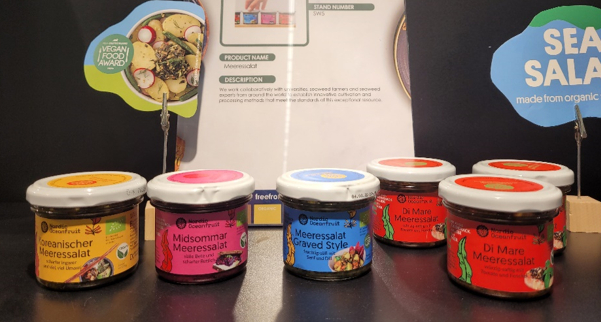
Image by: Eva Hannigan
Snacks
Fewer and simpler ingredients were the driving themes in the snack category, following the overall market trend that snacking is no longer just associated with indulgence and unhealthy treats but with nutritional benefits and substantial consumption (Bord Bia, 2021). Polish company Pop Crop’s blue corn tortilla chips and organic blue corn popcorn, promoted the crop’s antioxidant benefits and each product containing only three ingredients. Other common claims included GMO-free, gluten-free and vegan, which have been found by Mintel (Mintel, 2021) to be some of the highest growing claims in the snack category.
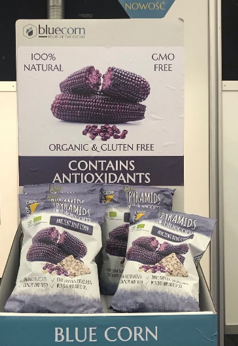
Image by: Eva Hannigan
Key Challenges and Concluding Thoughts:
While the Netherlands is a potentially good market for free from products, there are challenges that suppliers should consider. The premiumisation of this sector, for example, has both pros and cons. While certain demographics may be willing to spend more on free from/alternative products, lack of affordability is also one of the biggest deterrents for consumers repurchasing from this category at 47% (Bord Bia, 2021). A further 27% find a flexitarian, vegetarian or vegan lifestyle difficult to maintain due to a lack of convenience (Bord Bia, 2021).
Nevertheless, the free from landscape in the Netherlands is expanding and becoming increasingly competitive. As plant-based and specialised diets continue to grow and consumers become more engaged with their health through food, suppliers in this field will likely need strong differentiating features in their products.
Sources:
Bord Bia, 2021. Dietary Lifestyles - The Netherlands. [online] Bord Bia Thinking House. Available at: <https://www.bordbia.ie/industry/insights/publications/dietary-lifestyle-report-march-2021/> [Accessed 29 November 2021].
Interreg 2 Seas and Noordzee Boerderij. (2019). Study on existing market for algal food applications: Seaweed. ValgOrize EU. Retrieved from https://www.noordzeeboerderij.nl/public/documents/Valgorize-D4.1.1A_Study-on-the-existing-market-for-seaweed-food-applications.pdf
Mintel. (2021). Free From Snack Analysis. Mintel GNPD
ProVeg. (2021). What consumers want: A survey on European consumer attitudes towards plant-based foods. Smart Protein EU. Retrieved from https://proveg.com/wp-content/uploads/2021/11/FINAL_Pan-EU-consumer-survey_Country-Specific-Insights-2.pdf