

5 reasons why cocoa prices are surging
John Tobin, Data and Inteligence Specialist
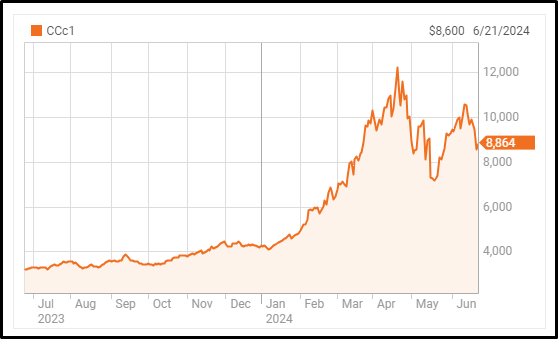
Earlier in the year it was reported the surge in cocoa prices was the primary reason Easter eggs were both more expensive and were smaller than prior years. Such is the seriousness of the issue that this concern was highlighted in the US Presidents State of the Union address (Financial Times, 2024). However, since then cocoa prices have continued to soar, representing a threefold increase on prior year levels and have become much more volatile in recent months too.
US Cocoa Prices as of June 21st 2024
Source: Reuters
This price surge is due to a number of contributory factors some of which could mean high chocolate prices may persist beyond the short term due to the following, which will be discussed in this article:
- Global supply deficit
- Weather issues
- Lack of incentives for producers from rising prices
- Deteriorating faith in futures markets
- European legislation
Global supply deficit
This has been a feature of the cocoa market in recent years with global stocks at historical low levels with the last three seasons including the current season resulting in a global deficit of cocoa (i.e. demand exceeding global production). Coupled with the expectation of another supply shortfall for the upcoming season (StoneX, 2023). Such is the concern that by mid-April cocoa prices had surged and briefly exceeded a record breaking US$12,000 per tonne. Currently prices are in the range of US$8,000 to US$10,000 per tonne. Which still represents a significantly elevated price compared with the range seen over the last 25 years of approx. US$2,000 to US$4,000 per tonne (Trading Economics, 2024).
Weather Issues
As with any agricultural commodity weather patterns have an effect on production and supply. However, with four fifths of global production derived from just two countries in West Africa, namely Ghana and the Ivory Coast (Statista, 2022), can contribute to the global cocoa market becoming even more exposed to weather patterns. According to the Economist, in April this region was battered by storms at the end of 2023, and then more recently was affected by a drought and heatwaves. The latter resulting in cocoa trees being affected by fungal and viral issues hurting yields further (The Economist, 2024).
Lack of incentives from rising prices
Typically, with such high prices relative to historical levels, this would create a significant opportunity for producers to expand production to boost their profitability. However, the situation is exasperated by the structural nature of the industry in Ghana and the Ivory Coast. This is due to producers, largely operating on a small scale and the prices they receive, fixed by the government which are currently believed to be insufficient to invest fertiliser, pesticides and new plants. Hence, growers are currently insensitive to higher prices in addition to many of the trees old and unproductive. This is despite both countries increasing prices last September and once more in April of this year (The Economist, 2024). In South America, producers are expanding in response to higher prices (The Economist, 2024), though new trees only start to yield pods by the fourth or fifth year, so the impact from this will not be immediate (Mondelez, 2024).
Lack of faith in futures markets
In addition to the above challenges, there are also concerns amongst traders surrounding the ability of Ghana and the Ivory Coast to honour contracts in full (Financial Times, 2024b). While Ghana’s financial crisis and debt default is another factor keeping buyers out of the market. Ultimately, this has meant that traders have become increasingly cautious in trading in this commodity and open interest (the number of outstanding contracts in cocoa) has more than halved (Y charts, 2024). The implication is that with a decline in liquidity (i.e. the number of contracts traded) can mean single trades can have an outsized impact on prices (The Economist, 2024), thus can create further volatility.
European Legislation
Lastly the EU Deforestation Regulation will apply from December 30th of this year. In order to be in compliance companies will need to do the following (EU Commission, 2024):
- Prove the cocoa beans are not sourced from a plot of land deforested after December 31st 2020 – geolocation data of the area of production must be collected
- Produced in line with relevant legislation in the country of production
- Product must be covered by a due diligence statement
- To be completed by importers, which must be checked by manufacturers and retailers to ensure due diligence has been exercised upstream in the supply chain
- Small and Medium Enterprises do not need to check or submit due diligence statements for products that have already been subject to this further up the supply chain.
- Such enterprises are defined by the Commission as having less than 250 employees, an annual turnover of less than €50 million or an annual balance sheet not exceeding €43 million and are independent* (Department of Enterprise Trade and Employment, 2024).
It is expected compliance with this legislation will be challenging as the industry relies on smallholder farmers. Consequently, cocoa traded in London now demands a premium of more than $400 per tonne when compared with prices on the US market. A tenfold increase compared with March of this year (The Economist, 2024).
In conclusion, it appears that high chocolate prices may not be cured by high prices in the short term. With The Economist, suggesting the era of cheap chocolate may soon be over as companies will either have to accept lower profits or pass on higher costs to the consumer. In addition, legislative changes may increase the cost along with the expenses associated with compliance. Irish brands involved in using cocoa as an ingredient or involved in the production of chocolate will need to pay close attention to the market. to seek out and evaluate potential opportunities. Bord Bia has a number of resources that can help client companies and their employees stay abreast of developments covering the outlook for the global cocoa market and more recently are in the process of obtaining pricing data on cocoa too. To explore these resources further click here – to complete Bord Bia desk research.
*No more than 25% of the capital or voting rights can be owned by one or more enterprises which fall outside the SME definition
References:
Department of Enterprise Trade and Employment (2024). What is the Commission’s definition of an SME? [online] Enterprise.gov.ie. Available at: https://enterprise.gov.ie/en/faqs/what-is-the-commission%E2%80%99s-definition-of-an-sme-
.html#:~:text=The%20Commission%20considers%20a%20company [Accessed 31 May 2024].
Financial Times (2024a). ‘Shrinkflation’ is coming for your Easter egg. [online] www.ft.com. Available at: https://www.ft.com/content/02f3475b-3c5f-4685-83a2-f8026afc63b2 [Accessed 2Financial Times (2024b). Cocoa hits record high as global shortage worsens in first quarter. [online] www.ft.com. Available at: https://www.ft.com/content/0709ee7e-a6df-43b3-81c3-afaa219df06d [Accessed 31 May 2024].
9 May 2024].
Mondelez (2024). Cocoa Growing. [online] Cocoa Life. Available at: https://www.cocoalife.org/in-the-cocoa-origins/ [Accessed 31 May 2024].
Statista (2022). Cocoa production by country 2018/2019 | Statista. [online] Statista. Available at: https://www.statista.com/statistics/263855/cocoa-bean-production-worldwide-by-region/ [Accessed 31 May 2024].
StoneX (2023). Overview of the cocoa market. Bord Bia.
The Economist (2024). Why the global cocoa market is melting down. [online] The Economist. Available at: https://www.economist.com/finance-and-economics/2024/05/09/why-the-global-cocoa-market-is-melting-down [Accessed 31 May 2024].
Trading Economics (2024). Cocoa | 2019 | Data | Chart | Calendar | Forecast | News. [online] Tradingeconomics.com. Available at: https://tradingeconomics.com/commodity/cocoa [Accessed 31 May 2024].
Y charts (2024). ICE Cocoa Futures Open Interest Weekly Trends: Commitments of Traders | YCharts. [online] ycharts.com. Available at: https://ycharts.com/indicators/ice_cocoa_futures_open_interest_ct#:~:text=ICE%20Cocoa%20Futures%20Open%20Interest%20is%20at%20a%20current%20level [Accessed 31 May 2024].
More Insightful Articles

5 Key Areas where AI will shape the Food and Drink Industry
Learn More
Advancing Beef Sustainability: Key Insights from the 2024 GRSB Board Meeting
Learn More
French beef market forecast 2024: Production still declining, consumption expected to stabilize
Learn More