Defra BTOM Update & Webinars
Defra has published the below additional information on the Border Target Operating Model. They are also hosting the below webinars to further explain this additional information.
Find out more about changes to import controls in Defra's January webinars;
Border TOM: Prepare for import controls for animal products from 31 Jan 2024
Tuesday 9 January 2024 at 10.00am
Register
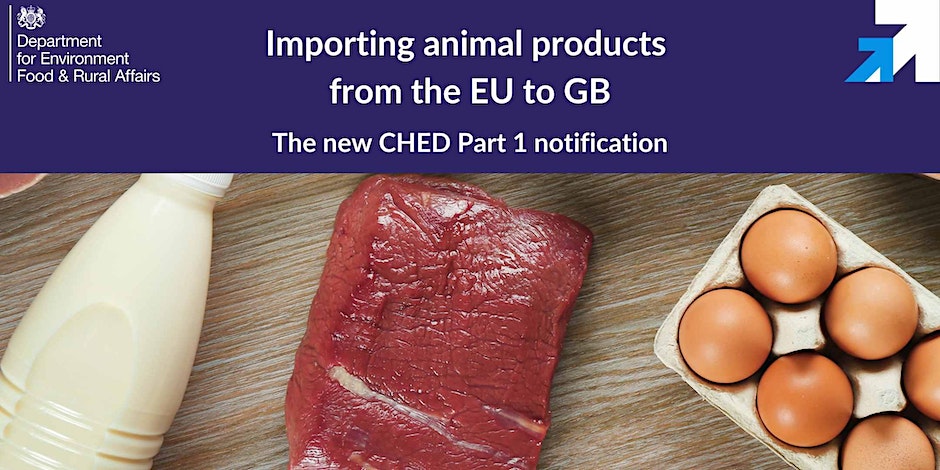
Importing POAO from the EU to GB: the new CHED Part 1 notification from 31 January 2024
Thursday 11 January 2024 at 2.00pm
Register
Prepare for the upcoming import controls from Jan'24 (plants focused)
Tuesday 16 January 2024 at 14.00 pm
Register
Re-Exports (Triangular Trade) Update
Under the Border Target Operating Model (BTOM), low risk goods that are imported to Great Britain will not need a health certificate. However currently, where goods originate from outside of the EU, a certifying officer can rely on information in the export health certificate that accompanied the goods into GB to re-certify a commodity for export.
From 30 April 2024, under the BTOM, a health certificate will no longer be required to import some low-risk POAO from non-EU countries to Great Britain. Therefore, where EU and ROW origin POAO are being re-exported, and no health certification will be required for import into Great Britain, certifiers may need to obtain additional supporting information.
Further guidance on what the additional supporting information looks like has now been published on gov.uk.
Find out more on Re-exports and relevant supporting information for certifiers Find out the Risk Category of your goods
If you need further information, please contact APHA Centre for International Trade.
Email: exports@apha.gov.uk
EU Risk Category – Commodity Code Update
Defra have updated their guidance for traders relating to the risk categorisation of EU animal products under the BTOM. This update does not change the risk categorisation in any way, rather it expands their existing guidance and provides additional detail for stakeholders.
Their guidance on EU risk categorisation under the BTOM sets out the risk categories in a table format, covering all animals and animal product types. It also includes a look-up tool designed to help find the BTOM risk category by CN code.
The look up tool does not currently cover all commodity codes for import. However, the most recent update to the tool adds additional commodity code information for codes "1504101000, 1504109100, 1504109900, 1504201010, 1504201090, 1504209000" to include a Product of Animal Origin (POAO) risk categorisation.
Defra have also added IPAFFS codes for CHED-P commodities currently included in this searchable list. This means it will now be possible to view information on a commodity's IPAFFS code and risk rating when searching the list with a 10 digit commodity code. They will update the searchable list with CHED-A commodity IPAFFS codes in due course.
Importers and import agents must use IPAFFS to notify authorities in Great Britain before the following goods arrive from EU: live animals, germinal products, animal by-products (ABP), high-risk food and feed not of animal origin (HRFNAO), products of animal origin (POAO), composite food products (if applicable), plants and plant products.
The look-up tool is designed to help traders find the BTOM risk category for specific commodities. It does not set out all import requirements for all SPS commodity codes. The trader is responsible for ensuring goods are categorised correctly in line with the published BTOM categorisation summary tables. Traders should understand their products and what their product’s intended uses are, so they are best placed to confirm the correct categorisation. Traders will need to be sure they are making the correct SPS classification so that, if applicable, their products undergo any required checks.
Find out more on Risk Categories for the EU Countries here
Final reminder - Extension of deadline to apply for funding to build border control posts for live animal imports.
The UK government has relaunched its Animal Biosecurity Infrastructure Fund to increase capacity for live animal import checks for maritime trade routes in England (excluding Kent). Eligible businesses can apply now to build a BCP (Border Control Post) for the import of live animals from the EU until the extended date of 20 December.
The fund will cover the eligible costs of building BCP's in England for the import of live animals from the EU.
Eligible applicants can apply for up to £10 million as part of the fund to cover costs such as:
- Construction and building materials
- Buying land
- Modifying or extending existing BCPs to handle animal imports
- Demolition
- Installation and assembly
- Staff costs or professional fees that are directly related to the construction of the BCP.
You may also be eligible for reimbursement of costs if you have already started to build a BCP.
Maritime ports and commercial operators that are interested in applying to the fund must complete the following two steps:
Defra officials will send you an e-mail within 3 working days to acknowledge your intention to apply. The deadline to complete the above two steps is set at 11:59pm on 20 December 2023.
|