1st January 2024
- UK Address
From 1 January 2024, all pre-packaged food sold in Great Britain must include a UK address for the Food Business Operator (FBO) on product labels, or the address of the UK-based importer if the FBO is not located in the UK.
Pre-packaged food items sold in Northern Ireland must include a Northern Irish or an EU address for the FBO on labels.
For imported products, the name and address of the business on food labels must be the body that takes legal responsibility for the information on the product label in the UK market. The new rules state that addresses on product labels must be physical locations. PO Boxes, email addresses or a phone number is insufficient for the new changes required.
There are several options available for Irish food producers to ensure that they comply with the labelling requirements by 1 January 2024.
| Option |
Considerations |
| Use your own business entity in the UK This can be a viable option if you already have a physical office or presence in the UK. |
The initial and running costs of setting up and maintaining a new entity in the UK market |
| Use your distributor/importer’s address This can be a viable option if you have a longstanding relationship and they are happy to take on the role |
The entity who first puts the product on the market in the UK will become the importer, are they willing to take on this responsibility? Do they fully understand the legal responsibilities? Will this tie you to a particular distributor/importer, and what are the implications if there is a breakdown in the relationship? |
| Use a Third Party Authorised Representative This can be a viable option if neither of the previous options apply or appeal. |
Pricing structures and rates (usually a set-up fee and an on-going subscription). Do they understand the specific requirements of the food industry (different requirements to other industry segments)? |
31st January 2024
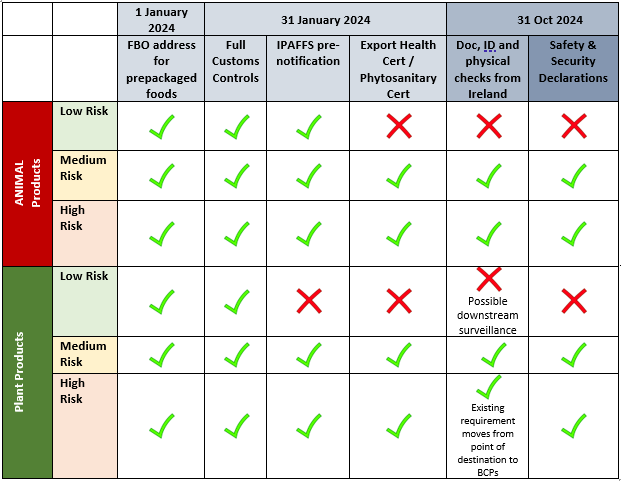
From 31 January 2024, full customs controls will apply to all products of animal origin, plants and plant-based products exported from Ireland to GB.
- UK IPAFFS (Import of Products, Animals, Food and Feed System)
All products of animal origin, plants and plant-based products - except low-risk plant products - will need to pre-notify the products on UK government IPAFFS system. Details of how to register for IPAFFS and how to pre-notify the arrival of your product to the UK can be found on the UK Government IPAFFS site.
- Export Health Certificates/Phytosanitary certificates
All medium and high-risk products of animal origin, plants and plant-based products will need an export health certificate or a phytosanitary certificate for export to the GB market.
Animal Products: Under the new BTOM, new, simplified Export Health Certificates are required for all medium risk and high risk animal products.
Plant Products: Under the new BTOM, Phytosanitary certificates are required for all medium risk and high risk plant products. A Phytosanitary Certificate can be obtained from the National Plant Protection Organisation (NPPO) from the country of origin of the plant or plant product.
The specific timeline and the actions you need to take are based on the risk categorisation and the type of your product. Under the BTOM there are 3 levels of risk (high, medium, low) for both animal and plant product types.
The UK Department for Environment Food and Rural Affairs (DEFRA) has published a list of plant risk categories. For animal products, consult the risk categories for animal products where you can find a summary list and a detailed list which can be searched based on commodity code.
It is essential to understand your risk categorisation, as the requirements differ based on your product type and risk categorisation. Risk categorisation is a dynamic process, which means risk categorisations may change over time. If they do, there will be an announcement and a 3-month lead time for implementation of the new categorisation.
30th April 2024
- Border Checks from 31st October 2024 for Ireland still to be confirmed.
All products of all risk levels except low risk plants will need to enter via a Border Control Post designated for that commodity type. BCP physical checks for live animals will commence from late 2024.
High risk products of both types (animal and plant) will be subject to documentary checks and physical and identity checks at the border.
Typically live animals will be subject to 100% document, physical and identity checks (with some exceptions).
High risk plants will be subject to 100% documentation checks and 5%-100% physical and identity checks.
Existing inspections of high-risk plants/plant products from the EU will move from point of destination in Great Britain to UK Border Control Posts.
Medium risk animal products, will be subject to 100% documentary checks and risk-based physical and identity checks typically 1% - 30%.
Medium risk plant and plant products imported to Great Britain from the EU, will be subject to documentary checks and risk-based physical and identity checks typically between 3%-5%. But this excludes goods being imported from Ireland. The date for implementation of border checks for these products from Ireland is still under discussion.
Low risk animal products will be required to have commercial documentation but will not routinely be required to have checks on documentation, identity, or physical checks under BTOM.
Low risk plant products will not be subject to routine documentation, physical or identity checks at the border, but may be subject to surveillance checks to ensure the low risk categorisation is appropriate over time. The surveillance may happen at border or downstream.
31st October 2024
- Safety and Security Declarations