

Start-up Trends Catalysed by Covid
August 10th 2020
Finnian O'Luasa, Manager France & Belgium, Bord Bia - The Irish Food Board
In questioning how a post Covid normal may be it is legitimate to analyse which consumer behaviours will remain in the future compared to changes observed during the lock down phases in different countries. A detailed analyses has been carried out on these behaviours by Bord Bia in various countries and available the Future proofing part of our website.
Another interesting approach to take is to analyse behaviour of start-ups in the food sector to detect trend changes. This has been carried out by Digital Food Lab, a Paris based FoodTech insight and strategy consultancy.
Their latest observations list start ups that help restaurants move online such as the Belgium company Deliverect, or the French company Tiller that provides hand held cash register and integrated app and data solutions. Others help restaurants centralise their procurement and suppliers to centralise orders with apps such as choco. With the increased use of plastic during Covid there is also an increase in start-ups aiming to reduce environmental impact such as Lactips that produce edible and biodegradable packaging from milk casein.
According to Digital Food Lab’s latest “Foodtech in Europe” report, 2019 was a record breaking year for European Food tech with 2.4€Bn euros being raised from private capital, 70% more than in 2018. The top 4 funding deals concerned delivery: Deliveroo (UK), Glovo (Spain); Picnic (NL), Wolt (Finland).
The next (5th and 6th place) concerned agritech with Ynsect who grow insects to make high quality animal feed (France) and Infarm; an urban farming concept (Germany). The remaining 4 start ups in the top 10 are Mathem (delivery), Wynd (logistics and multichannel facilitation), Gousto (delivery) and Flashenpost (delivery). As can be seen therefore 7 of the Top 10 concern delivery innovation and 2 concern food tech to reduce environmental impact.
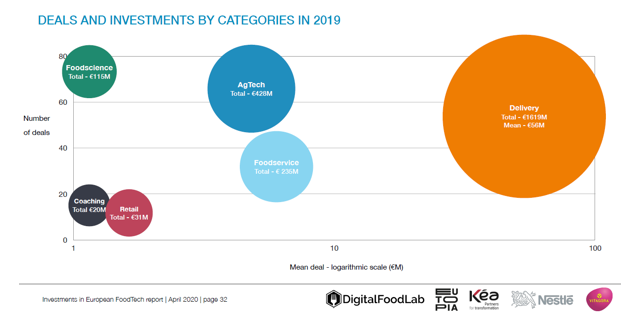
Trends we see in startups concide with Future proofing trends in Bord Bia’s toolkit, notably in minimising trips to shop (according to the report over 7 in 10 (72%) of French adults have minimised their trips to the shop as a result of Covid-19 and the majority of this cohort expect this behaviour to continue post pandemic) and eating healthier for improved immunity. Although many of the start up trends detected date pre Covid, this recent crises would appear therefore to act as a catalyser to trends already emerging.